Snail mucin is the ingredient people either swear by or refuse to touch. It sits in the top tier of K-beauty search terms year after year, shows up in essences, serums, and creams at every price point, and still triggers the same two questions: does it actually do anything, and is it as weird as it sounds?
Short answer: it is a genuinely good hydrator with some interesting supporting evidence, and most of the magic attributed to it belongs to more boring explanations. Here is what the ingredient actually is, what the research supports, and how to decide whether it deserves a slot in your routine.

What Snail Mucin Actually Is
The ingredient listed as snail secretion filtrate is the filtered, purified version of the mucus snails produce to protect and repair their own bodies.
No snails are present in the bottle — what remains after filtration is a cocktail of glycoproteins, glycosaminoglycans, hyaluronic acid, zinc, and small amounts of glycolic acid.
That composition explains most of what the ingredient does. Glycosaminoglycans and hyaluronic acid are large water-binding molecules — the same category of humectants you already know from other products.
They grab moisture and form a light, flexible film on the skin surface. The texture people describe as slimy is that film doing its job.
What the Research Supports
The evidence base is real but smaller than the marketing suggests. Lab and animal studies on snail secretion filtrate show faster wound closure, better collagen deposition, and reduced inflammation in injured tissue.
A 2024 review in the Journal of Cosmetic Dermatology summarized the cosmetic uses — hydration, anti-aging, acne scarring, hyperpigmentation — while stressing that most human studies so far are small.
Translated into practical terms, here is how the five most common claims hold up.
| Claim | Evidence | What it means for you |
|---|---|---|
| Hydration | Strongest and most immediate | The humectant film measurably improves moisture and smoothness |
| Barrier support | Reasonably solid | Hydrated skin repairs itself better, and the filtrate seems to support that process |
| Soothing | Reasonably solid | Anti-inflammatory signals in wound models match what users report on irritated or freshly exfoliated skin |
| Deep wrinkle reversal | Not supported | The plumping is temporary hydration, not structural change |
| Dramatic dark spot fading | Weak | The trace glycolic acid is far below a concentration that meaningfully resurfaces skin |
Where It Fits in a Routine
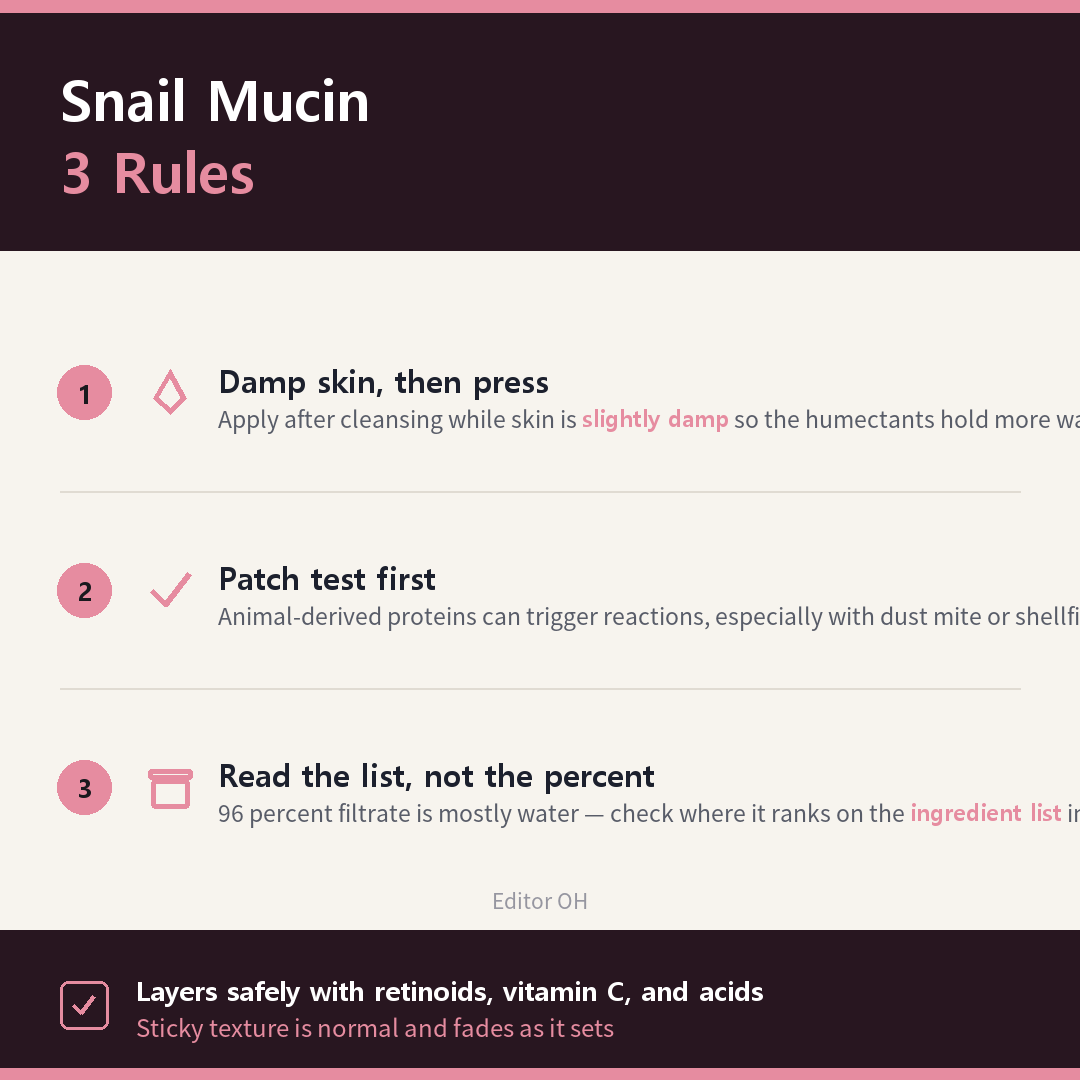
Snail mucin behaves like a hydrating essence or serum, so it slots in after cleansing and before heavier creams. The classic K-beauty move is pressing it into slightly damp skin, which gives the humectants more water to hold onto.
It layers politely with almost everything. It does not conflict with retinoids, vitamin C, or exfoliating acids — in fact it works well as a buffer step on nights when actives leave your skin tight.
If your routine already ends with an occlusive moisturizer, snail mucin underneath is one of the lower-risk additions you can make.
Who Should Think Twice
Three groups should pause before jumping on the trend.
- Allergy-prone users: snail secretion is an animal-derived protein mix, and reactions, while uncommon, do happen. People with dust mite or shellfish allergies show up disproportionately in reaction reports. Patch test on your inner arm for a few days first
- Vegans and the squeamish: this is an animal-derived ingredient, full stop. Ethical harvesting claims vary by brand and are hard to verify. Plant-based humectants like beta-glucan and tremella mushroom extract cover similar hydration ground
- Fungal-acne-prone skin: the glycoprotein-rich film can sit heavily on skin prone to malassezia flare-ups. If that is you, introduce it slowly and watch for congestion
How to Pick a Product That Isn't Just Marketing
Concentration claims are where snail products get slippery. A label shouting 96 percent snail secretion filtrate sounds impressive, but the filtrate itself is mostly water — the number tells you little about how much active material you are getting. More useful signals:
- Position on the ingredient list: snail secretion filtrate should sit in the first few slots, not after the preservatives
- Simple formulas first: if you are testing whether the ingredient works for you, a short ingredient list makes the answer readable. A formula stuffed with twenty extras tells you nothing about the snail part
- Texture preference: essences are lighter and layer under anything; creams anchor the ingredient in a richer base. Neither is more effective — pick what your routine has room for
Quick FAQ
Can I use snail mucin every day?
Yes. It is a hydrator, not an active, so daily use morning and night is the norm. There is no purge period and no need to build tolerance.
Does snail mucin help with acne?
Indirectly at best. It calms irritation and supports healing of post-blemish marks, which can make an acne-prone routine more comfortable. It does not treat the causes of acne — keep your actual treatment steps and use snail mucin as support.
Why does it feel sticky, and does that mean it's working?
The stickiness is the glycoprotein film, and it fades as the product sets. It is a texture signature, not an effectiveness meter — a formula that feels less tacky is not doing less.
Snail mucin gets marketed with the same regeneration language as PDRN, another animal-derived K-beauty star — we examined how well that claim holds up in our PDRN deep dive.
For the research itself, the 2024 review of snail extract in dermatology is indexed on PubMed, and INCIDecoder lets you check where snail secretion filtrate ranks in any product's formula before you buy.
Are you team snail or still hesitant? Tell us what's holding you back — or what converted you — in the comments. We update these guides as new research lands.
Comments
Post a Comment