Every dupe post follows the same script. Two bottles, one costs four times the other, and a screenshot of both ingredient lists sits between them as proof.
The lists do look nearly identical. That is the part everyone stops at.
What almost nobody explains is how much an ingredient list is allowed to leave out, and where on the label the useful information runs out. Once you know that, you can check a dupe claim yourself in about five minutes.
What an ingredient list is required to do
An ingredient list is not a recipe. It is a legal disclosure, and it has one rule at its centre: order.
In the United States, cosmetic ingredients must be declared in descending order of predominance. The European regulation says the same thing in different words, ordering by weight at the point the ingredients are added.
Korean law follows the identical principle. Ingredients run from most to least, and every one of them has to appear.
So position carries real information. Water listed first means water is the largest single component. Niacinamide listed third means only two things outweigh it.
What the list never gives you is a number. Order, yes. Amount, no. That gap is where most dupe arguments quietly fall apart.
The 1 percent line
Here is the part that breaks nearly every side-by-side comparison you have read.
The descending-order rule only applies above 1 percent. Ingredients used at 1 percent or less may be listed in any order the manufacturer prefers, provided they come after everything above 1 percent.
This is not a loophole somebody discovered. It is written into the American, European and Korean rules alike.
The consequence is blunt. Partway down every ingredient list, order stops meaning anything at all. Below that point the sequence is arbitrary, and comparing two products by their eleventh and twelfth ingredients is comparing noise.
You cannot see the line. Nothing marks it. But you can usually estimate where it falls.
Preservatives are the landmark. Phenoxyethanol, one of the most common, is capped at 1 percent in the European regulation. Once it appears, you are at or below the line.
Fragrance, colourants and plant extracts cluster in the same region. A list that trails off into fifteen botanical names is describing fifteen things that may together amount to a rounding error.
How to compare two products in five minutes
With the line in mind, checking K-beauty dupes becomes mechanical rather than a matter of squinting at two screenshots.
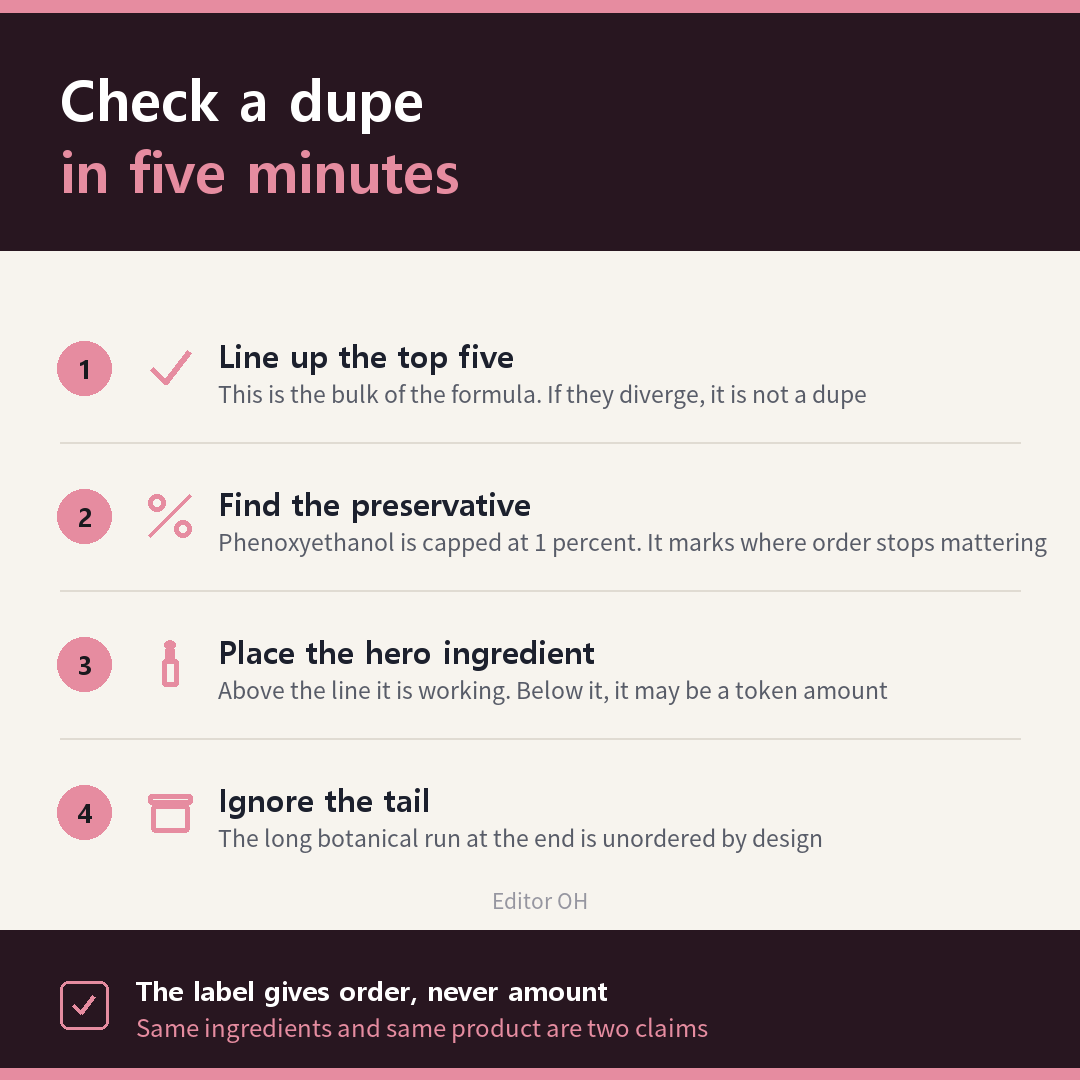
| Step | What to do | What it tells you |
|---|---|---|
| 1 | Line up the first five names in both lists | This is the bulk of the formula. If the top five diverge, it is not a dupe |
| 2 | Find the preservative | Roughly marks where 1 percent begins. Stop weighing order past it |
| 3 | Locate the hero ingredient | Above the line it is doing work. Below it, it may be a token amount |
| 4 | Compare the texture agents | Thickeners, silicones and esters decide how it feels, which is most of the daily experience |
| 5 | Ignore the tail | The long botanical run at the end is unordered by design |
The recommendation that falls out of this is simple. If the top five match and the hero ingredient sits in the same neighbourhood, the two products are genuinely close. If they do not, the resemblance was cosmetic.
What the list still cannot tell you
Two products can carry an identical ingredient list and behave differently on skin. The list is a set of names, and names omit most of what decides how a formula performs.
- Concentration: niacinamide in third position could be 2 percent or 10 percent. The label reads the same either way
- Grade and purity: one name covers raw materials at different molecular weights, purities and prices. Hyaluronic acid is the obvious case, where the same word covers materials that behave nothing alike
- pH: many actives only work inside a narrow pH window, and nothing on the label tells you where the formula sits
- Delivery system: encapsulation and emulsion structure change how much of an ingredient reaches anything at all
- Texture and finish: the difference people actually notice day to day is spread, absorption and residue, and that comes from processing as much as from composition
This is why "same ingredients" and "same product" are two different claims. The first can be checked from the box. The second cannot.
When a dupe is genuinely a dupe
Sometimes the resemblance is real, and the structure of Korean manufacturing is the reason.
A large share of Korean skincare is produced by contract manufacturers rather than by the brand printed on the bottle. A brand commissions a formula, the manufacturer makes it, and the same facility serves many brands at once.
Products built that way can sit far closer together than two independently developed formulas ever would. Base formulas get reused, adjusted at the margins and sold again.
What you will rarely be able to do is confirm a specific pairing. Manufacturing relationships are not published, and claims about which brands share a factory are usually rumour dressed as insider knowledge.
The workable version is weaker and more honest. A near-identical top five makes a shared base plausible. It does not make it proven.
The bottom line
An ingredient list is evidence, not proof. It settles what is in a product and roughly in what order. It says nothing about how much, at what grade, or how well.
Compare the top five. Find the preservative. Check where the hero ingredient sits relative to it. Then stop, because past that point the label has run out of things to tell you.
The practical recommendation is unglamorous. When the top of the list matches and the price gap is wide, buy the cheaper one and accept that the texture may not match. That is where the saving actually is, and it is the one part of the comparison the label can support.
Ingredient names carry less weight than the marketing around them implies, which is the same lesson as the PDRN evidence check. Concentration and formulation matter more than tidy pairing rules, which is what came up in the retinol and vitamin C guide.
The ordering requirement is set out in 21 CFR 701.3 for the United States and in Article 19 of Regulation 1223/2009 for Europe. Korean cosmetic labelling is administered by the Ministry of Food and Drug Safety, and individual ingredient entries can be looked up on INCIDecoder.
In short: the top five ingredients decide whether a dupe is real, and everything below the 1 percent line is printed in whatever order the manufacturer chose. A matching tail proves nothing.
Which dupe actually held up for you, and which one felt completely different? Leave a comment. If enough pairs come in, the next round can go category by category.
Comments
Post a Comment