Almost every skincare guide repeats the same warning: never use retinol and vitamin C together. The reasoning sounds technical enough to be convincing, and it gets copied from article to article until it reads like settled science.
It is not. The pH argument behind the rule describes what happens in a beaker, not what happens on skin. The real limit on using both is far more ordinary, and most guides skip it entirely.
What the "never mix" rule actually claims
The argument runs like this. L-ascorbic acid, the purest form of vitamin C, needs a low pH to stay stable and absorb well, usually somewhere around 2.5 to 3.5. Retinol converts more efficiently at a higher pH, closer to 5 or 6.
Put them in the same layer, the theory goes, and each one drags the other out of its ideal range. Both end up doing less than they would alone.
The chemistry is real. The conclusion drawn from it is where things go wrong.
What it gets wrong about skin
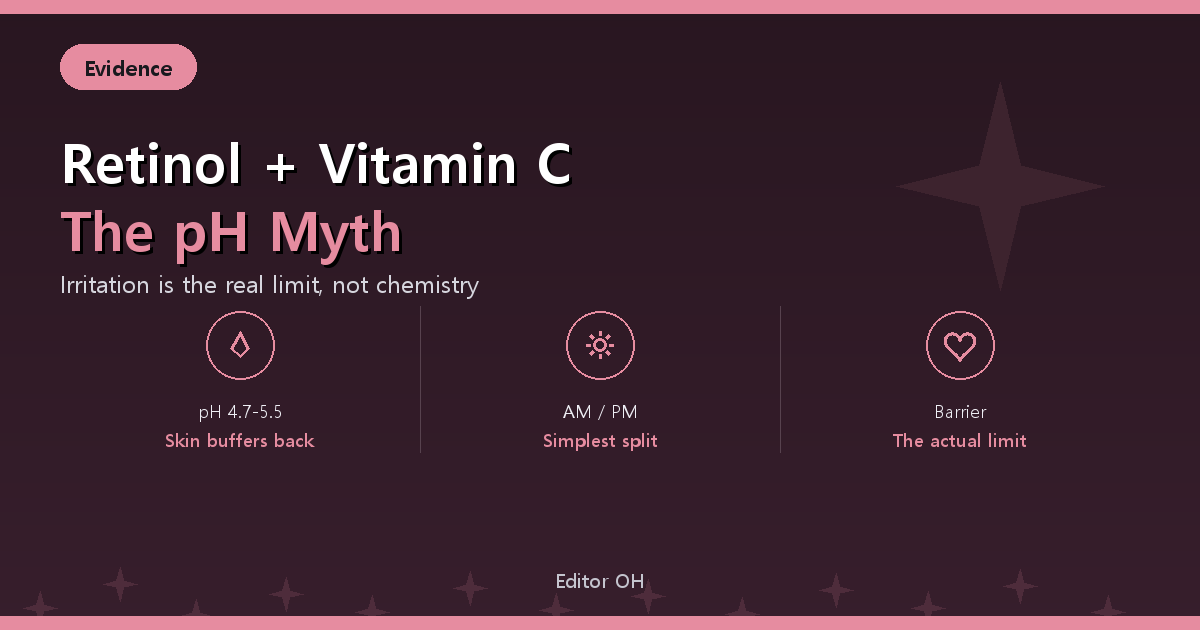
Healthy skin sits at a pH of roughly 4.7 to 5.5. It is already acidic, and it buffers whatever you put on it back toward that range within minutes. A product does not hold your face at pH 3 for the rest of the evening.
Retinol also does not stop working in mildly acidic conditions. Prescription tretinoin has been used alongside acidic formulations for decades in dermatology practice without the pairing being treated as a problem.
The beaker experiment and the face are two different environments. Formulators account for this, which is why stabilized derivatives and encapsulated retinol exist in the first place.
What the research supports
Reviews of topical anti-aging regimens consistently place retinoids as the core active and treat vitamin C as a complementary addition rather than a conflicting one.
A 2023 review in Clinics in Plastic Surgery describes photoprotection and topical retinoids as the foundation of an anti-aging routine, with vitamin C and niacinamide layered on according to individual concerns.
That same review flags the point most layering guides miss. Stability and absorption are the genuine considerations, and a simpler routine reduces irritation and improves the odds that someone actually sticks with it.
Work on pigmentation points the same direction. A review in the Journal of Dermatological Treatment covering ascorbic acid, retinoids and combination protocols found that multi-ingredient approaches are standard practice for hyperpigmentation, not something clinicians avoid.
The downside nobody mentions
Here is the part that actually matters, and it has nothing to do with pH.
Both ingredients irritate. Retinol disrupts the barrier while skin adjusts to it. L-ascorbic acid at the concentrations that make it effective stings on compromised skin. Stack them in one sitting and the likely outcome is not wasted product but a wrecked barrier.
Redness, flaking and stinging that lasts for days is the real cost, and it is worse for anyone who is new to retinol or already dealing with sensitivity. K-beauty routines make this easier to stumble into, because layering four or five thin steps is normal and it stops feeling like stacking actives.
If your barrier is already unhappy, pull the actives back and rebuild first. A centella-based routine is the more useful move than pushing through irritation.
How to layer them
Three approaches work, and they differ mostly in how cautious you need to be.
| Approach | How it works | Best for |
|---|---|---|
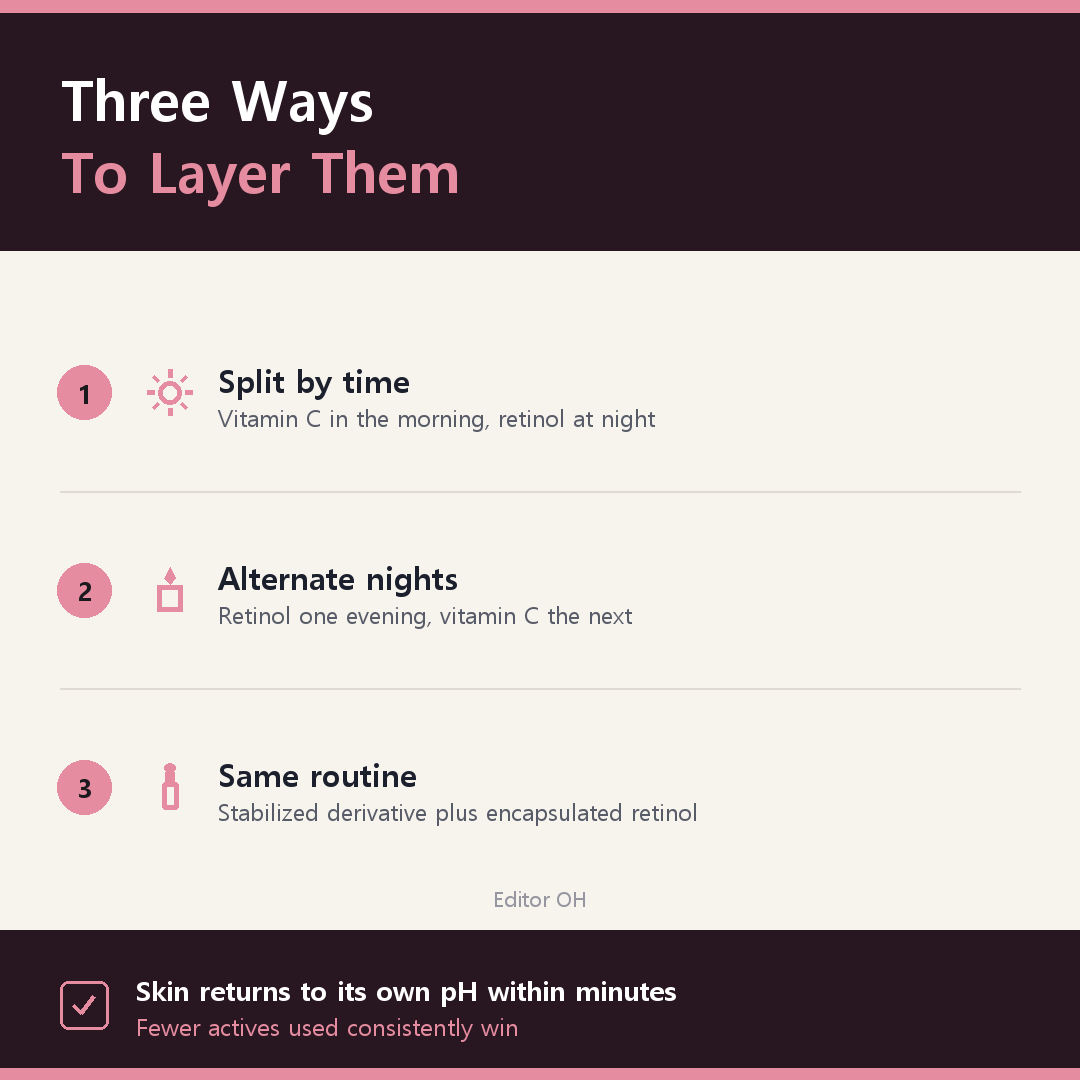
| Split by time | Vitamin C in the morning, retinol at night | Most people, especially beginners |
| Alternate nights | Retinol one evening, vitamin C the next | Sensitive skin building tolerance |
| Same routine | Stabilized vitamin C derivative plus encapsulated retinol, buffered with moisturizer between | Experienced users with a settled barrier |
The morning and night split is the default for a reason. Vitamin C pairs naturally with daytime sun protection, and retinol degrades in UV light, so the timing solves two problems at once rather than one.
If you go with the third option, look for magnesium ascorbyl phosphate or sodium ascorbyl phosphate rather than straight L-ascorbic acid. These derivatives are stable at higher pH and far gentler, which removes the conflict the myth was built on.
Who should skip this entirely
- Anyone in their first eight weeks of retinol. Add nothing until your skin has adjusted
- Active eczema, rosacea or a damaged barrier. Both actives will make it worse
- Anyone using prescription tretinoin. Ask the prescribing clinician before adding anything acidic
- Pregnancy. Retinoids are not recommended, and this is a conversation for a doctor rather than a blog
Reviews consistently mention that people abandon routines because of irritation, not because the routine was too simple. Fewer actives used consistently will outperform an ambitious lineup that gets dropped after two weeks.
The same logic applies to barrier-support ingredients like snail mucin, which are far easier to sustain than a stack of strong actives.
The bottom line
The pH conflict is overstated and was never the real problem. Irritation is. Split them between morning and night, not because the molecules cancel out, but because your barrier can only take so much in one sitting.
If you have been avoiding one of the two because the internet told you they were incompatible, the good news is that you were probably never choosing between them. You were only choosing when to use each.
Have you been keeping retinol and vitamin C apart, or using them in the same routine? Tell us how your skin handled it in the comments. We update these guides as new research lands.
Comments
Post a Comment