Every autumn the same advice arrives. Switch to something richer, the weather is changing.
It is not wrong, but it points at the wrong thing. The measurements that actually move do not track the outdoor forecast. They track the room you are sitting in.
Here is what researchers measured across seasons, what six hours in a heated room does to skin, and how to change a routine based on that rather than on the calendar.

Both numbers move the wrong way at once
A cohort study followed 72 women across all four seasons, measuring the same points on the cheek and forearm each time.
Two readings matter here. Stratum corneum hydration is how much water the surface holds. TEWL is how fast water escapes through the barrier.
| Measure (cheek) | Peaks | Lowest |
|---|---|---|
| Hydration | Summer | Winter |
| Sebum | Summer | Winter |
| TEWL | Winter | Summer |
Read the columns together. Going into winter, water content falls and water loss rises at the same time. Sebum, which would normally slow the loss, falls with them.
That is three things moving against you in the same direction. It is not one problem with three symptoms.
Six hours is enough
The more useful finding comes from a Korean randomized split-face study on healthy skin in winter.
Participants spent at least six hours a day in an indoor environment with the heater running. That is a normal working day, not an extreme exposure.
After six hours, skin temperature, pores, roughness, redness and wrinkles all increased significantly on the face. On the forearm, TEWL rose significantly.
Six hours. Not a season, not a month. One day indoors with the heating on produced measurable change in people whose skin was healthy to begin with.
This reframes the whole question. The outdoor temperature is something you pass through. The heated room is where you actually spend the day, and the air in it is drier than the air outside.
Why your face lies to you
There is a detail in that study worth pulling out.
TEWL rose significantly on the forearm, not on the face. The authors note that sebum secretion appeared to function as a barrier maintaining homeostasis on facial skin.
In other words the face is partly defended. Oil production buffers it, so the barrier reading holds better there than on a body site with fewer sebaceous glands.
The practical consequence is that your arms and legs tell you first. If the backs of your arms feel rough in October, that is the signal, and the face is likely further along than it looks.
Waiting until the face flakes means acting late.
How to change the routine
The steps follow from the measurements rather than from the season.
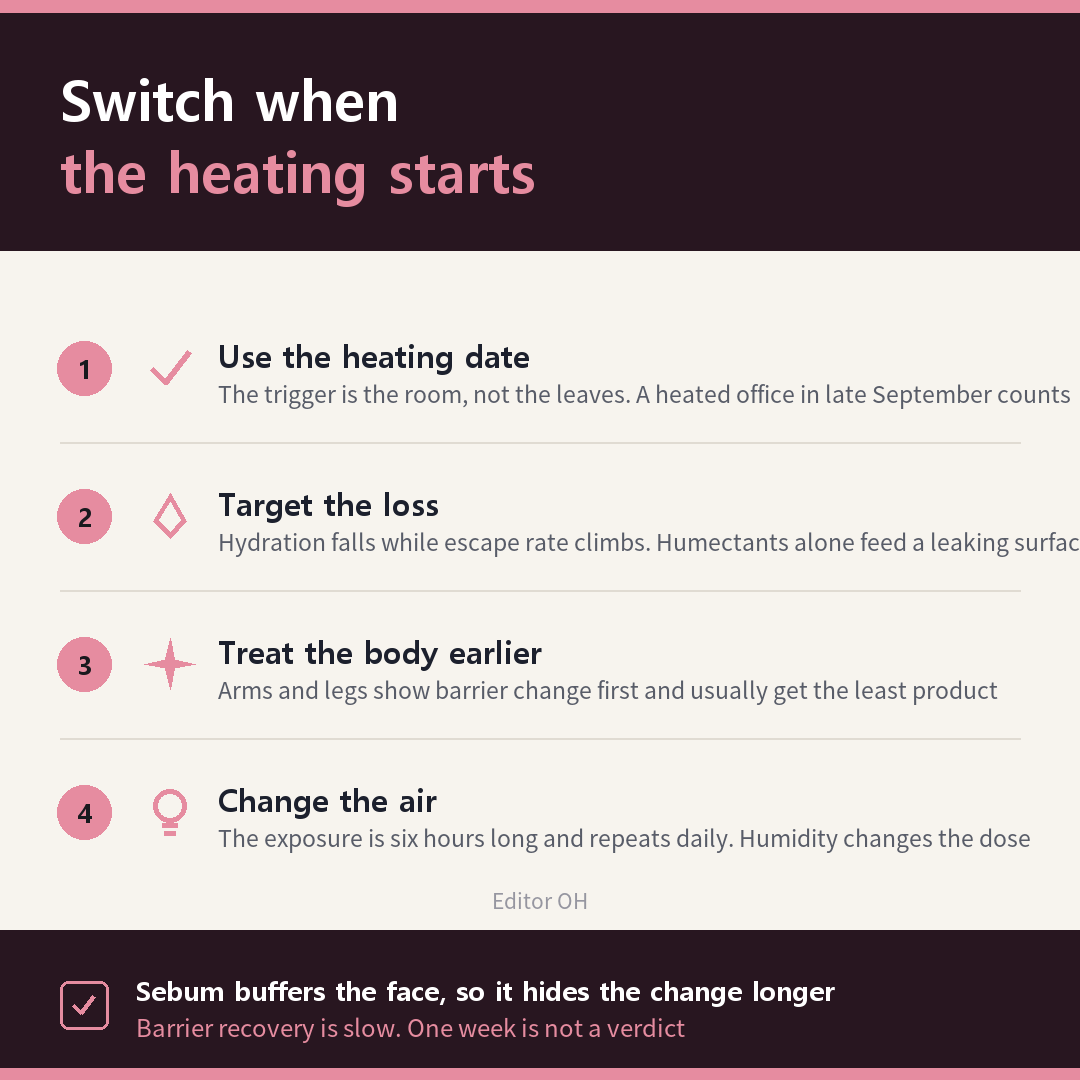
- Switch when the heating goes on, not when the leaves turn: the trigger is the room. If you are in a heated office in late September, that is your date
- Target the loss, not just the water: hydration is falling and escape rate is rising. A humectant alone adds water to a surface that is leaking faster than before
- Treat the body earlier than the face: arms and legs show barrier change first, and they usually get the least product
- Add humidity to the room: the exposure is six hours long and repeats daily. Changing the air changes the dose
- Give it a few weeks: barrier recovery is slow, and one week of a new cream is not a verdict
What the ceramide arm showed
The same study applied cream to one side of the face and left the other untreated, which makes the comparison unusually clean.
On the ceramide-treated side, elasticity, pores, texture and wrinkles improved relative to the untreated side. Moisture content was significantly higher on the forearm as well.
The authors' recommendation is direct: creams containing ceramide help maintain homeostasis and protect the barrier during prolonged indoor exposure in winter.
Worth keeping in scale. This is one study on healthy skin over a short exposure, and the participants were all women in Korea. It supports barrier lipids as a reasonable autumn adjustment. It does not make any particular product necessary.
What this does not mean
It does not mean the outdoor season is irrelevant. Cold dry air outside is part of why indoor air gets dry once it is heated.
It also does not mean everyone needs a heavier cream. Someone who spends the day outdoors in mild weather is on a different exposure schedule than someone under office heating from nine to six.
And measured change is not the same as damage. The studies here describe shifts in healthy skin, not injury. Persistent irritation, cracking or a rash is a dermatologist's territory rather than a routine question.
The bottom line
Autumn skincare advice is usually framed around weather. The measurements point somewhere more specific: hydration and sebum fall while water loss rises, and six hours in a heated room is enough to register.
So the useful trigger is not a date on the calendar. It is the first week your heating runs all day, and the first place to look is your forearms.
The distinction between water content and escape rate is covered in more depth in the oily skin and barrier guide, and the layering question that comes up when you add a richer cream on top of actives is in the retinol and vitamin C guide.
Both studies above are indexed on PubMed. The Korean indoor-environment trial is Effects of winter indoor environment on the skin, and the four-season cohort is Seasonal variations of epidermal biophysical properties. Korean cosmetic regulation is administered by the Ministry of Food and Drug Safety.
In short: the season is not what changes your skin. The heated room is. Water content drops while escape rate climbs, six hours registers, and your forearms show it before your face does.
Does your skin change more when the weather turns or when the heating comes on? Leave a comment. If enough cases come in, the next round can split it by indoor and outdoor routines.
This article summarises published research for general information and does not replace medical advice, diagnosis or treatment. Skin responses vary between individuals, and persistent irritation or cracking should be assessed by a qualified professional.
Comments
Post a Comment