There is a line that gets repeated in every oily skin guide. Your skin is actually dehydrated, so it overproduces oil to compensate. Add moisture and the oil settles down.
The advice at the end of that sentence is sound. The explanation in front of it is not what the measurements show.
What researchers actually find in oily, acne-prone skin is a different problem, and knowing which one you have changes what you reach for. Here is what the data says and how to build a routine around it.
Two different measurements, often confused
Skin researchers measure oil and water separately, because they are separate things.
Sebum is what the sebaceous glands push out onto the surface. Hydration is the water content of the stratum corneum. And a third measure sits between them: transepidermal water loss, usually shortened to TEWL, which is how fast water escapes through the skin.
TEWL is the barrier reading. A high number means water is leaving faster than it should, which points to a barrier that is not sealing properly.
The popular explanation collapses all three into one story. Skin is dry, so it makes oil. It is tidy, and it is why the advice usually arrives with a lot of confidence behind it.
What the study of 316 people found
A cross-sectional study published in 2024 measured these parameters in 316 volunteers, 164 with acne and 152 without.
| Measure | Acne group | Controls |
|---|---|---|
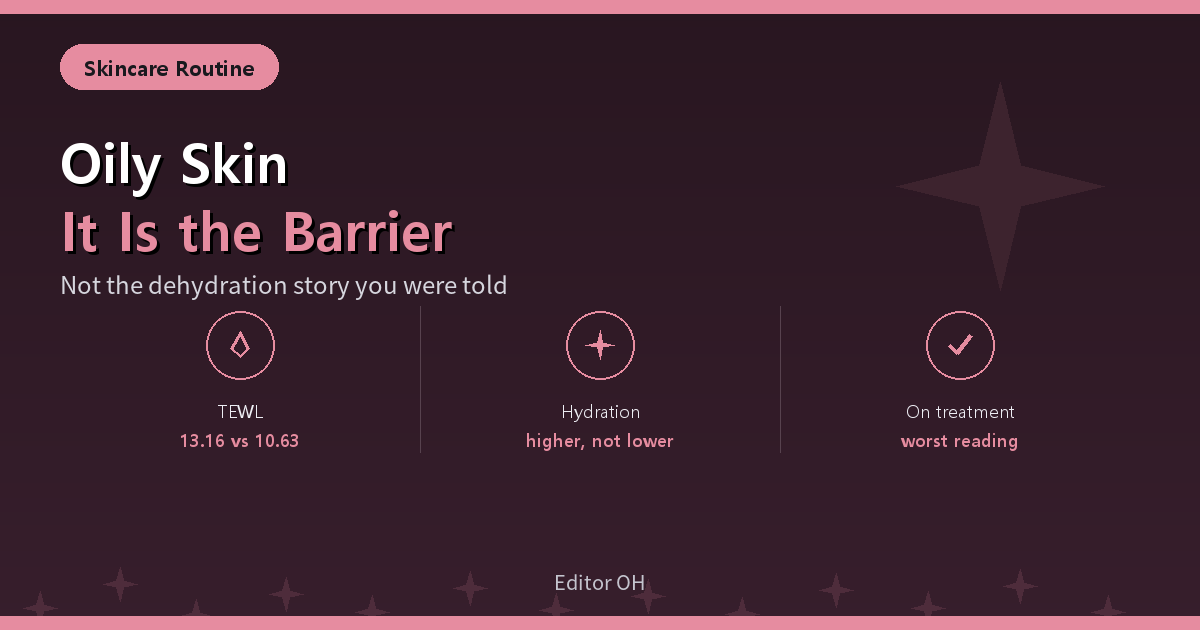
| TEWL (water loss) | 13.16 g/m²/day | 10.63 g/m²/day |
| Sebum | median 3 A.U. | median 0 A.U. |
| Hydration | 244.60 uS | 222.60 uS |
Read the third row again. The acne group measured higher on hydration, not lower. All three differences held after adjusting for confounding factors.
So the folk explanation does not survive contact with the instrument. These were not parched faces compensating with oil. They were faces losing water quickly through a compromised barrier while also producing more oil.
Barrier impairment and oiliness travel together. That is the finding. The causal story about dehydration triggering oil production is an extra claim the measurements here do not carry.
The part that matters most
The same study broke the acne group into treated and untreated, and the ordering is the useful bit.
The highest TEWL was in acne patients receiving treatment, followed by untreated acne patients, with controls lowest. Hydration followed a comparable pattern.
In other words, the products people reach for to fix oily, breakout-prone skin measurably degrade the barrier further while they work.
The authors' conclusion points straight at this. The findings support using moisturisers with barrier-enhancing properties in patients on acne medication.
This is a much better reason to add moisture than the dehydration story. It is specific, it is measured, and it tells you exactly when the need is greatest.
Oily is not one category
A 2025 classification study of 200 women aged 17 to 34 pushed this further, using 104 non-invasive parameters to sort skin objectively rather than by self-assessment.
Oily sensitive skin split into subtypes that behave differently:
- Barrier-sensitive: rough texture, high pH, prone to acne
- Neurosensitive: elevated TEWL and reactivity
- Inflammatory-sensitive: darker tone, low elasticity, uneven redness
The practical implication is that "oily skin routine" is a category label, not a prescription. Two people with the same oil reading can need different things.
A separate 2022 study of 74 acne patients adds one more piece. Alongside higher TEWL, pH, sebum and porphyrins, the acne group showed reduced skin microbiome diversity.
Both TEWL and sebum were negatively associated with that diversity. Stripping the surface harder is not a neutral act.
How to build the routine
The steps that follow from this are unglamorous and mostly about not making the barrier worse.
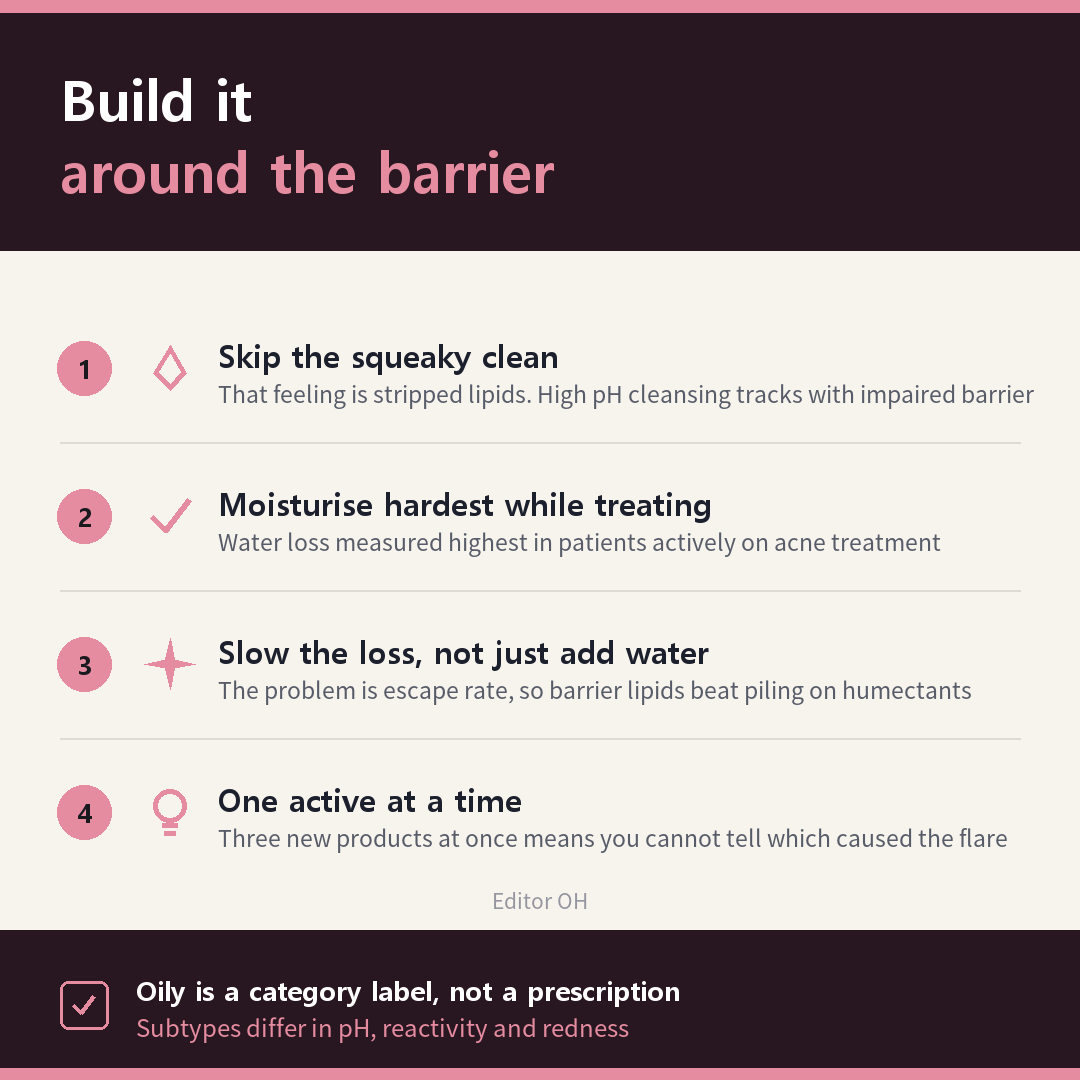
- Do not chase the squeaky-clean feeling: that sensation is stripped lipids. High pH cleansing shows up in the same measurements as impaired barrier
- Moisturise hardest while treating: this is where the data is most direct. If you are on an acne treatment, barrier support is not optional comfort, it is addressing a measured effect
- Separate the two jobs: humectants pull water in, occlusives and barrier lipids slow the loss. Oily skin usually needs the second one more than the first, since the problem is escape rate
- Introduce one active at a time: you need a baseline to judge against. Layering three new products means you cannot tell which one caused the flare
- Give it weeks, not days: barrier repair is slow, and the first week of any active is not representative
What this does not mean
None of this says to stop treating acne. The study measuring worse barrier readings in treated patients concluded that people should pair treatment with barrier support, not abandon treatment.
It also does not mean oil control is pointless. Sebum really was higher in the acne group. The point is that oil control alone addresses one of two measurements, and the other one is the one that makes skin sting, flake and react.
And these are population-level findings from specific cohorts. Individual skin varies, and a persistent or severe breakout pattern is a dermatologist's territory rather than a routine adjustment.
The bottom line
Oily skin does need more moisture. Just not because it is secretly dehydrated. It needs it because barrier impairment and oiliness show up together in measurement, and because the treatments aimed at the oil make the barrier reading worse while they run.
That reframing changes what you buy. The target is the escape rate, not the water content, which is why a routine built on barrier lipids tends to outperform one built on piling humectants onto a surface that cannot hold them.
Barrier irritation from combining actives is covered in the retinol and vitamin C guide, and the spot-treatment side, including what occlusion does to a lesion, is in the pimple patch breakdown.
The figures above come from research indexed on PubMed. The 316-person barrier study is Skin Barrier Parameters in Acne Vulgaris versus Normal Controls.
The subtype classification is A comprehensive classification and analysis of oily sensitive facial skin, and the microbiome findings are in Epidermal Barrier Integrity and Skin Microbiome in Acne Vulgaris.
Korean cosmetic regulation is administered by the Ministry of Food and Drug Safety.
In short: the measured problem in oily skin is how fast water leaves, not how little is there. Acne treatment pushes that number higher, which is exactly when barrier support earns its place.
Has adding a richer moisturiser made your skin less oily, or more? Leave a comment. If enough cases come in, the next round can split it by subtype.
This article summarises published research for general information and does not replace medical advice, diagnosis or treatment. Skin responses vary between individuals, and persistent or severe acne should be assessed by a qualified professional.
Comments
Post a Comment