Hyaluronic acid is on nearly every hydrating product in a Korean routine. The marketing rarely mentions the one number that changed the results in the study people cite.
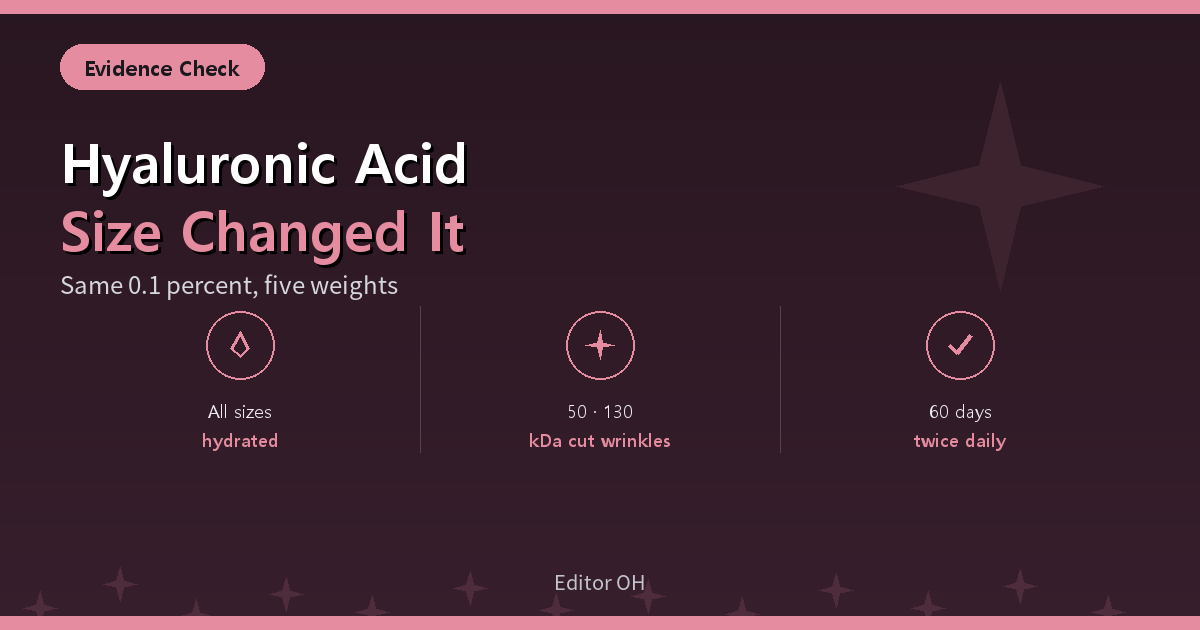
That number is molecular weight. A trial that compared five sizes of the same ingredient at the same 0.1 percent concentration found that all of them improved hydration, but only the two smallest reduced wrinkle depth.
Here is what the study measured, why size changes the outcome, and what it means for a bottle that only says hyaluronic acid on the front.
What it is
Hyaluronic acid is a sugar chain that holds water. Your skin already makes it. In a bottle it works as a humectant: it binds water and keeps it at the surface.
The chain can be long or cut short, and that length is what molecular weight describes. It is measured in kilodaltons, written kDa. A 2000 kDa chain is a long one. A 50 kDa chain is a fragment.
The size matters because skin is a barrier. A large chain sits on top as a film. A small one has a better chance of getting past the outermost layer.
That is the whole argument in one line. The same name on two labels can mean a film on the surface or something that travels a little further, and the front of the bottle does not separate them.
One study, five sizes, same concentration
The comparison comes from a randomised trial of 76 women aged 30 to 60 with visible wrinkles around the eyes.
Each participant applied a cream with 0.1 percent hyaluronic acid at one of five molecular weights around one eye twice a day for 60 days. Around the other eye they used the same cream without the active.
The measurements were skin hydration, elasticity, and wrinkle depth read from negative replicas of the skin surface.
| Molecular weight | Hydration · elasticity | Wrinkle depth |
|---|---|---|
| 50 kDa | Improved | Reduced |
| 130 kDa | Improved | Reduced |
| 300 kDa | Improved | No significant change |
| 800 kDa | Improved | No significant change |
| 2000 kDa | Improved | No significant change |
Every version beat the control cream on hydration and overall elasticity. That is the easy win, and it is why almost any hyaluronic acid product can claim a hydration result.
The split appears on wrinkle depth. After 60 days, only the 50 and 130 kDa groups improved significantly on roughness measures compared with the untreated side. The authors attributed it to better penetration by the smaller chains.
Why the label rarely tells you
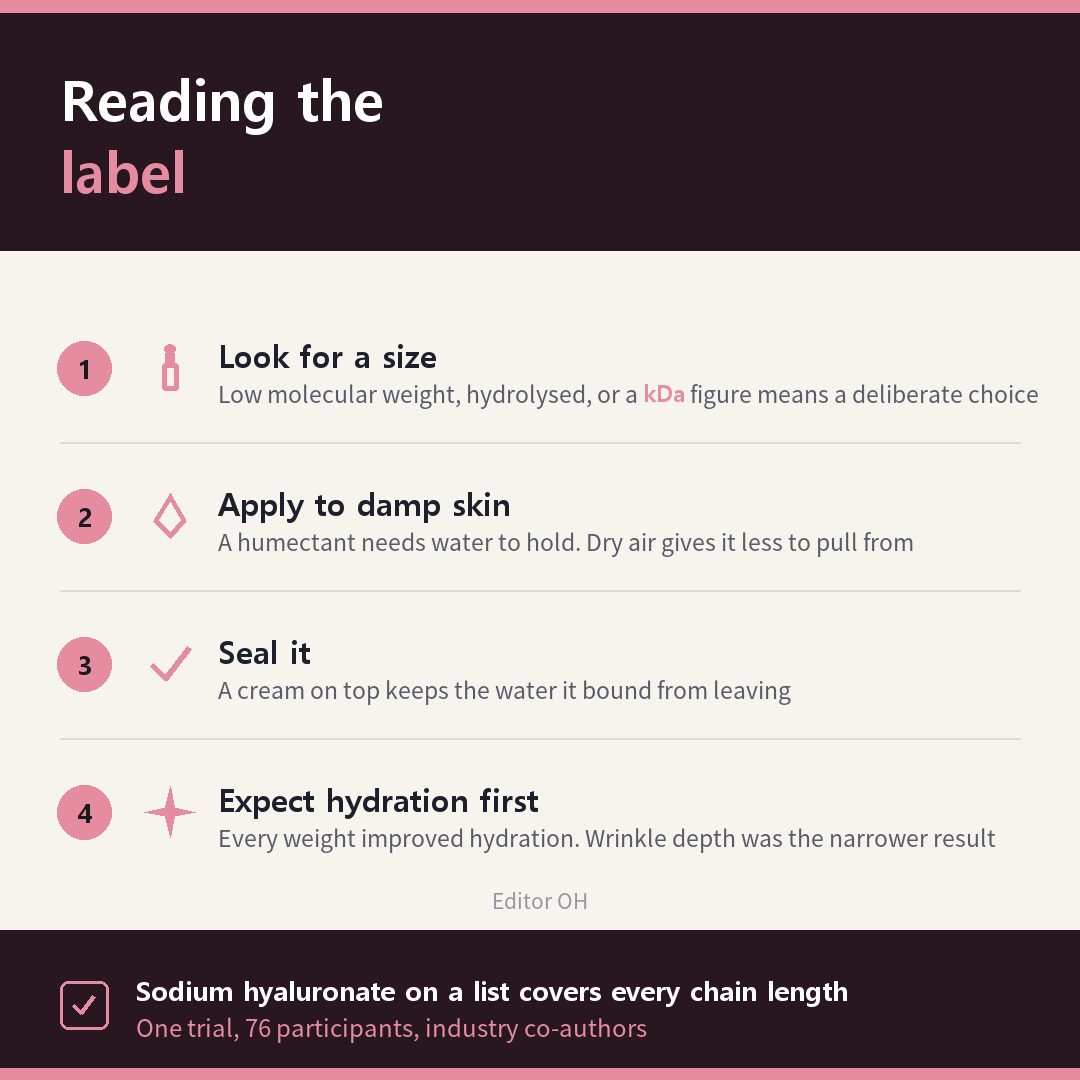
An ingredient list shows names, not chain lengths. Sodium hyaluronate covers every size in that table. Two products with identical ingredient lists can behave differently.
Some brands do say more. Terms like low molecular weight, hydrolysed hyaluronic acid, or a stated kDa figure signal that the formulator chose a size deliberately. A list of several hyaluronate variants usually means a blend of sizes.
None of that guarantees a better product. It is the difference between a claim you can check and one you cannot.
The humidity problem
A humectant pulls water toward itself, and where that water comes from depends on the air.
In humid air it draws from the environment. In very dry air there is less to pull from outside, which is why that layer can feel tight in a heated room and why it is usually applied to damp skin and sealed with a cream.
The seasonal version of that problem, measured in a heated indoor environment, is in the autumn routine guide.
What the study does not show
- It does not make small always better: one concentration, one body site, one duration were tested
- It does not measure filling: this was topical cream, not injectable filler, and the readings are surface measurements
- It does not last on its own: humectant effects depend on continued use, like most cosmetic results
- It was a single trial: 76 participants over 60 days, with industry co-authors on the paper
The downside of chasing low molecular weight
There is a debate in the literature about whether very small fragments of it can act as an inflammatory signal in skin. Most of that work is in cell and animal models rather than in people using cosmetics, and the trial above reported the low weights as well tolerated.
The honest summary is narrower than either marketing position. Smaller chains penetrated better and did more in that trial, and very small fragments remain an open research question. A blend of sizes is a reasonable middle, and how your own skin reacts outranks all of it.
The bottom line
Hyaluronic acid is not one ingredient with one result. At the same 0.1 percent, every size hydrated, and only 50 and 130 kDa reduced wrinkle depth.
So a product that names its molecular weight is telling you something the ingredient list cannot. If the goal is oil control or spot fading rather than hydration, the concentration evidence for those sits in the niacinamide guide.
The trial is indexed on PubMed as Efficacy of cream-based novel formulations of hyaluronic acid of different molecular weights in anti-wrinkle treatment, published in the Journal of Drugs in Dermatology.
Korean cosmetic labelling and functional cosmetic rules are administered by the Ministry of Food and Drug Safety.
In short: molecular weight decided what the same ingredient did. Everything hydrated. Only the smaller chains changed wrinkle depth. Look for a size on the label, apply to damp skin, and seal it.
Does your hyaluronic acid product state a molecular weight anywhere on the label? Leave a comment. If enough cases come in, the next round can compare how brands describe it.
This article summarises published research for general information and does not replace medical advice, diagnosis or treatment. Skin responses vary between individuals, and persistent irritation should be assessed by a qualified professional.
Comments
Post a Comment