Niacinamide serums now come in 10, 15 and 20 percent. The number on the bottle keeps climbing, and it is easy to read that as progress.
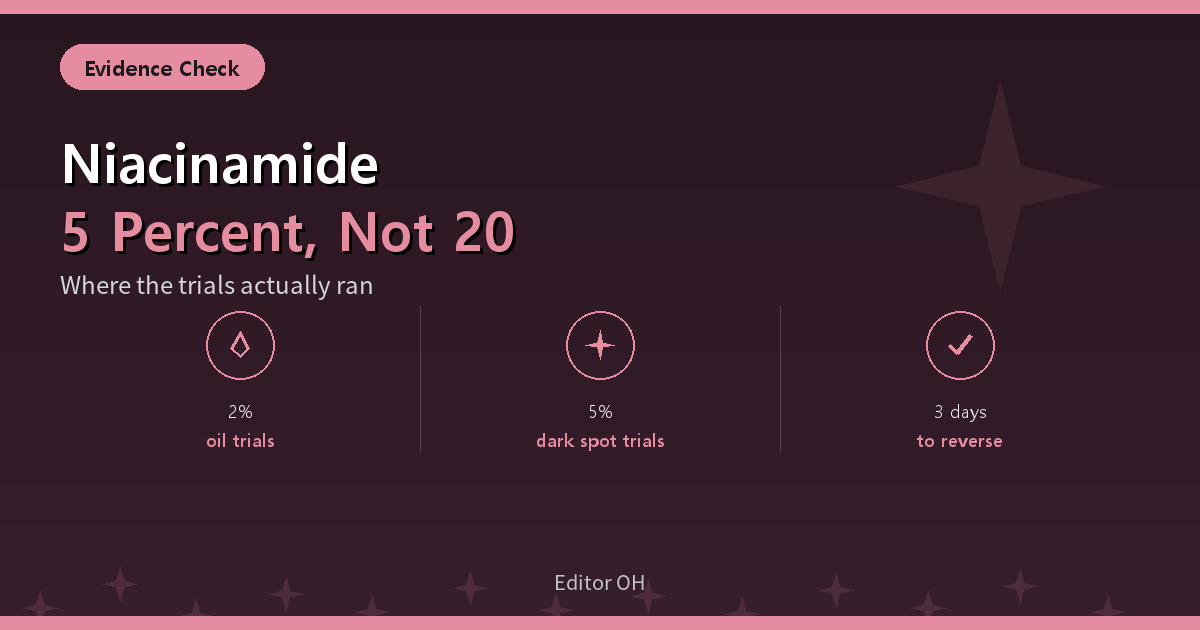
The clinical studies that made niacinamide famous were not run at those numbers. The sebum trial used 2 percent. The dark spot trials used 5 percent. Korea's own regulator lists niacinamide as a brightening ingredient at 2 to 5 percent.
Here is what those studies measured, what happens when you stop using it, and why a bigger percentage is not the same thing as more evidence.
What it is
Niacinamide is a form of vitamin B3. In skincare it is studied for two main jobs: reducing visible dark spots and lowering how much oil the face produces.
It is not the same molecule as niacin, the form associated with flushing when taken as a supplement. A safety review from the Cosmetic Ingredient Review panel assessed both together because their toxicology is similar, but on skin they are used differently.
That review found the ingredient produced no stinging at concentrations up to 10 percent in clinical testing.
Use tests plus a 21-day cumulative irritation test showed no irritation at concentrations up to 5 percent. Those are the upper bounds of what was tested, not a ceiling that was exceeded safely.
The oil study ran at 2 percent
The sebum work is a pair of trials run in Japan and the United States.
In Japan, 100 people were split into two groups. Fifty used a 2 percent niacinamide moisturiser for four weeks and fifty used a placebo moisturiser. The treated group showed a significantly lower sebum excretion rate at both two and four weeks.
In the US, 30 people used it on one side of the face for six weeks. Here the result was different. Casual sebum levels on the surface dropped, but the excretion rate did not significantly change.
So even at the same concentration, the two populations responded on different measures. The authors' conclusion was careful: 2 percent may lower excretion in Japanese participants and surface oil in Caucasian participants.
The point for anyone buying a serum is simpler. The oil-control evidence exists at 2 percent. It was never a high-dose finding.
The dark spot studies ran at 5 percent
The pigmentation work began with a mechanism question. In lab tests, it did not block tyrosinase, the enzyme most brightening ingredients target, and did not reduce melanin production in melanocytes grown alone.
What it did do was interfere with the next step.
In a model where pigment cells and skin cells were cultured together, it produced 35 to 68 percent inhibition of melanosome transfer, the handoff of pigment packets from the cells that make them to the cells that display them.
| Study | Concentration | Finding |
|---|---|---|
| Sebum, Japan | 2% | Excretion rate lower at 2 and 4 weeks |
| Sebum, US | 2% | Surface oil lower, excretion rate unchanged |
| Dark spots | 5% | Less hyperpigmentation than vehicle at 4 weeks |
| Reversibility | Split face | Dose dependent and reversible |
In the clinical arm, 18 people with hyperpigmentation used a 5 percent niacinamide moisturiser against a vehicle moisturiser. After four weeks, the treated side significantly decreased hyperpigmentation and increased skin lightness compared with vehicle alone.
A later pair of split-face trials in Japanese and Caucasian women also used 5 percent as the reference arm against a vehicle control.
It stops working when you stop
This is the detail most product pages leave out.
A follow-up study tested whether the transfer block was permanent. In culture, treated cells resumed normal melanosome transfer within three days of the ingredient being removed.
The same paper ran a vehicle-controlled split-face trial and found a dose-dependent and reversible reduction in hyperpigmented spots.
Reversible is the important word. The ingredient is not erasing pigment that has already been made. It is slowing delivery for as long as it is present. Stop applying it and the process goes back to its previous rate.
That makes consistency more valuable than strength. A 5 percent product used every day for months fits the evidence better than a 20 percent product used in bursts.
How to choose a product
The studies suggest a short checklist rather than a hunt for the highest number.
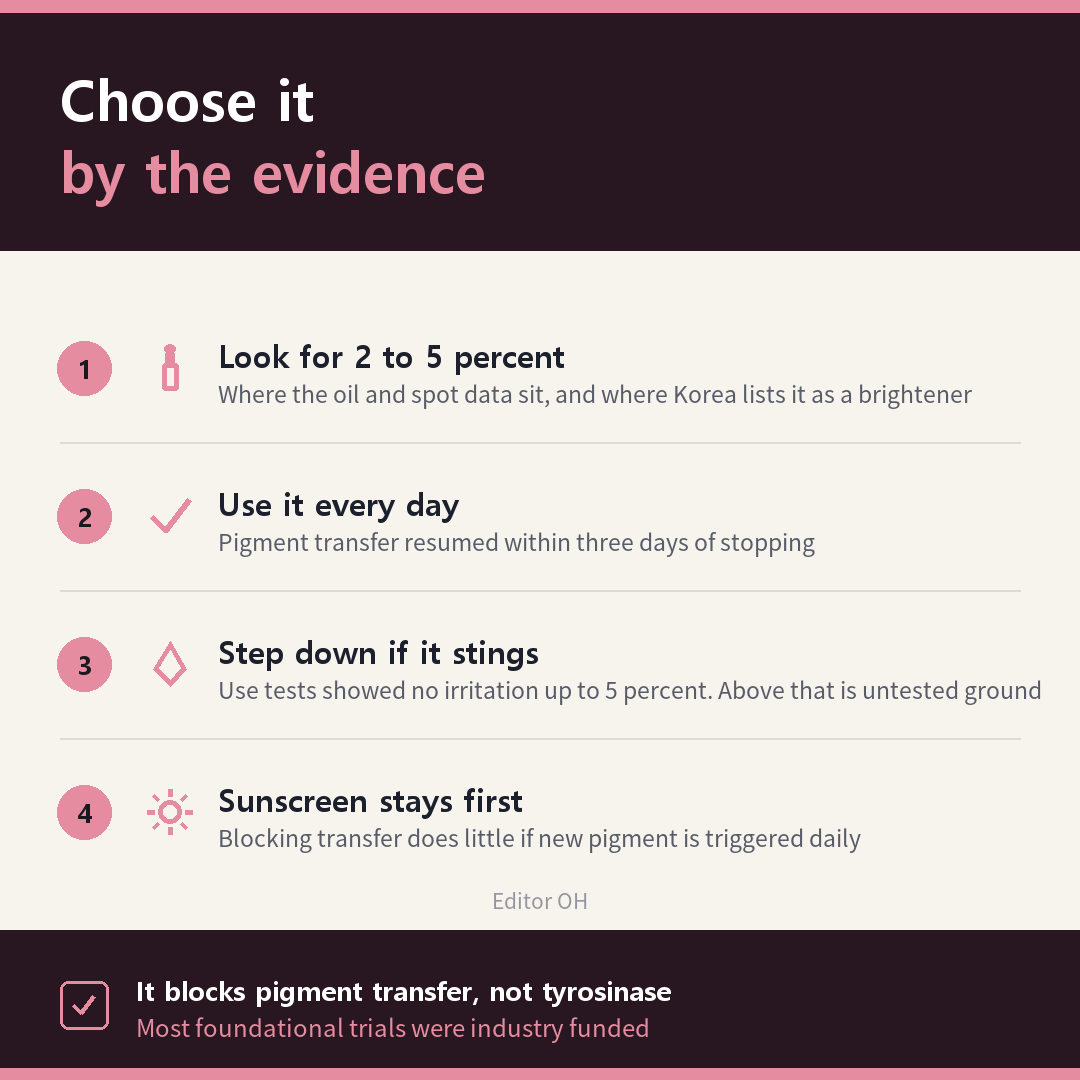
- Look for 2 to 5 percent: that is where the oil and spot data sit, and where Korea's functional cosmetic listing sits
- You need daily use, not a higher dose: the effect reverses when application stops
- Step down if you get stinging or redness: irritation testing tops out at 5 percent in use tests, so a reaction above that is outside the tested range
- Keep sunscreen as the first step: blocking transfer does not help if new pigment is being triggered every day
The downside of chasing percentages
High-percentage serums are not proven harmful. The honest position is narrower: the clinical evidence for benefit and the use-test evidence for tolerability were both built at or below 5 percent, and a stronger bottle moves outside that range.
There is also a funding context worth knowing. Most of the foundational pigmentation work, including a 2025 study pairing the ingredient with a low pH formula, came from researchers at a large consumer goods company.
That does not make the results wrong, and several trials were randomised and vehicle controlled. It does mean independent replication is thinner than the ingredient's popularity suggests.
And ingredient lists do not always tell you the percentage. Under Korean labelling rules, ingredients are listed in descending order, but anything at 1 percent or below can appear in any order. The details are in the ingredient list and dupes guide.
The bottom line
Niacinamide's reputation is real, but it was earned at modest concentrations. Two percent for oil, five percent for spots, and only for as long as you keep using it.
If dark marks after breakouts are the reason you are looking, prevention does more work than any brightening serum, as covered in the post-breakout dark spot review. If oil is the reason, the barrier side of that problem is in the oily skin guide.
The studies above are indexed on PubMed.
The pigmentation mechanism and 5 percent trial is The effect of niacinamide on reducing cutaneous pigmentation, the sebum trials are The effect of 2% niacinamide on facial sebum production, and the reversibility study is Effective inhibition of melanosome transfer is reversible.
The safety review is Final report of the safety assessment of niacinamide and niacin, and the low pH study is Synergistic effects of niacinamide and low pH. Korean functional cosmetic rules are administered by the Ministry of Food and Drug Safety.
In short: the evidence sits at 2 to 5 percent, not 20. It blocks pigment transfer rather than pigment production, the effect reverses within days of stopping, and daily use matters more than a higher number.
What percentage are you using, and did a higher one ever sting? Leave a comment. If enough cases come in, the next round can split results by concentration.
This article summarises published research for general information and does not replace medical advice, diagnosis or treatment. Skin responses vary between individuals, and persistent irritation or changing pigmentation should be assessed by a qualified professional.
Comments
Post a Comment