Large pores are usually explained with one word: age. Skin loosens, pores stretch, and there is not much to do about it.
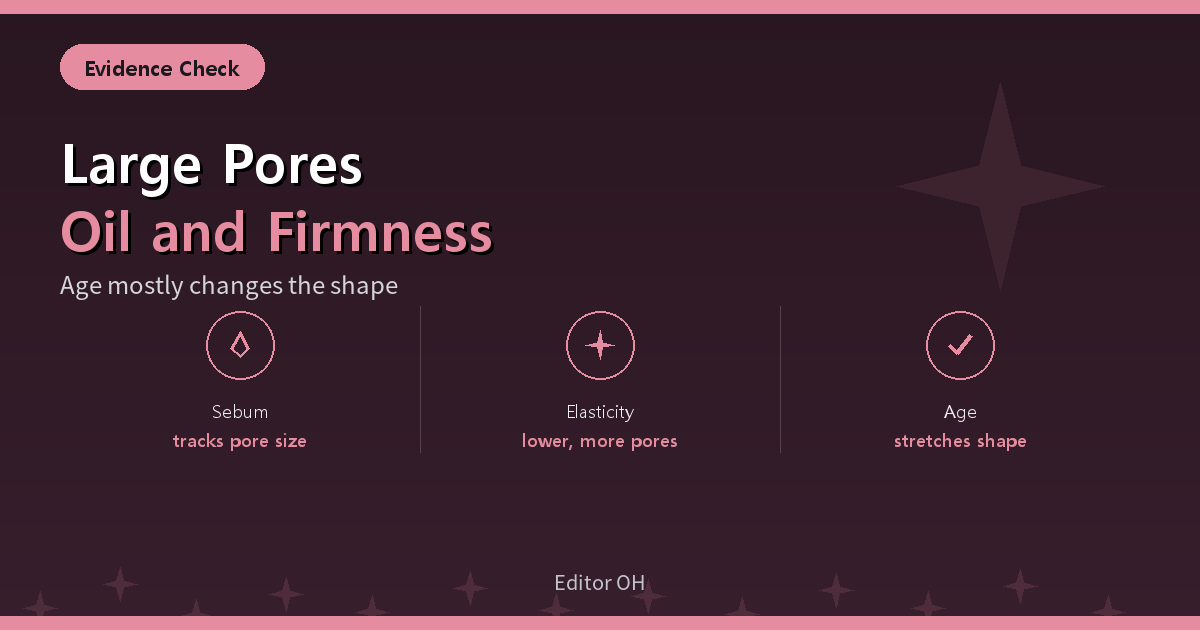
The measurement studies point somewhere more specific. When researchers put instruments on faces, the factors that tracked pore size were oil output and skin elasticity. Age, on its own, did not show a clear relationship in the Korean study that tested it directly.
Here is what those studies found, why age changes the shape of a pore more than its size, and what that means for a routine.
What it is that you are seeing
A visible pore is the opening of a hair follicle with an attached oil gland. Every face has them. What people call large pores is really how conspicuous those openings look under normal light.
That distinction matters because conspicuousness has more than one input. The opening itself, the oil sitting in it, and the firmness of the skin around it all change how it reads to the eye.
The Korean study that tested the usual suspects
A study at Seoul National University College of Medicine measured 60 volunteers, 30 men and 30 women. It checked pores against four commonly blamed factors: age, sex, oil output and skin elasticity, plus the presence of acne.
| Factor | Relationship with pores |
|---|---|
| Sebum output | Positive correlation |
| Skin elasticity | Lower elasticity, more pores |
| Male sex | More pores |
| Having acne | More pores |
| Age | No definite relationship |
| Acne severity | No definite relationship |
The authors' summary was direct: male sex, increased sebum and decreased skin elasticity were the factors most correlated with pore development. Age and acne severity did not show a definite relationship.
The sample was small and the authors asked for studies in broader populations. It is still one of the few that put all these variables into the same measurement.
Oil shows up again and again
The oil link is not a one-off.
A Japanese study of 38 women found that sebum output correlated with total pore area. The same study found that a growth-related hormone in the blood, IGF-1, correlated with both oil output and pore size. That points to oil production being part of the pore picture, not just a coincidence on the surface.
A 2026 study of 199 women aged 18 to 35 sorted participants into four groups by pore area. As pores got larger, water loss through the skin rose and elasticity fell, and oil showed an increasing trend with the largest group significantly higher than a smaller one.
Three studies, three countries, the same two variables keep surfacing: oil and firmness.
Age changes the shape, not the size
If age is not driving size, why do pores look different at 45 than at 25?
A study using high-magnification imaging on Caucasian women answered that directly. It found that pore size and density were not affected by aging, but pore shape became elongated. The authors linked it to changes in the micro-relief of the skin surface.
That matches what people describe. Pores do not necessarily get wider with time. They stretch into a teardrop or slit shape, which catches more shadow and looks bigger even at the same area.
It also connects back to elasticity. Skin that holds its structure less firmly lets openings pull out of round.
What this means for a routine
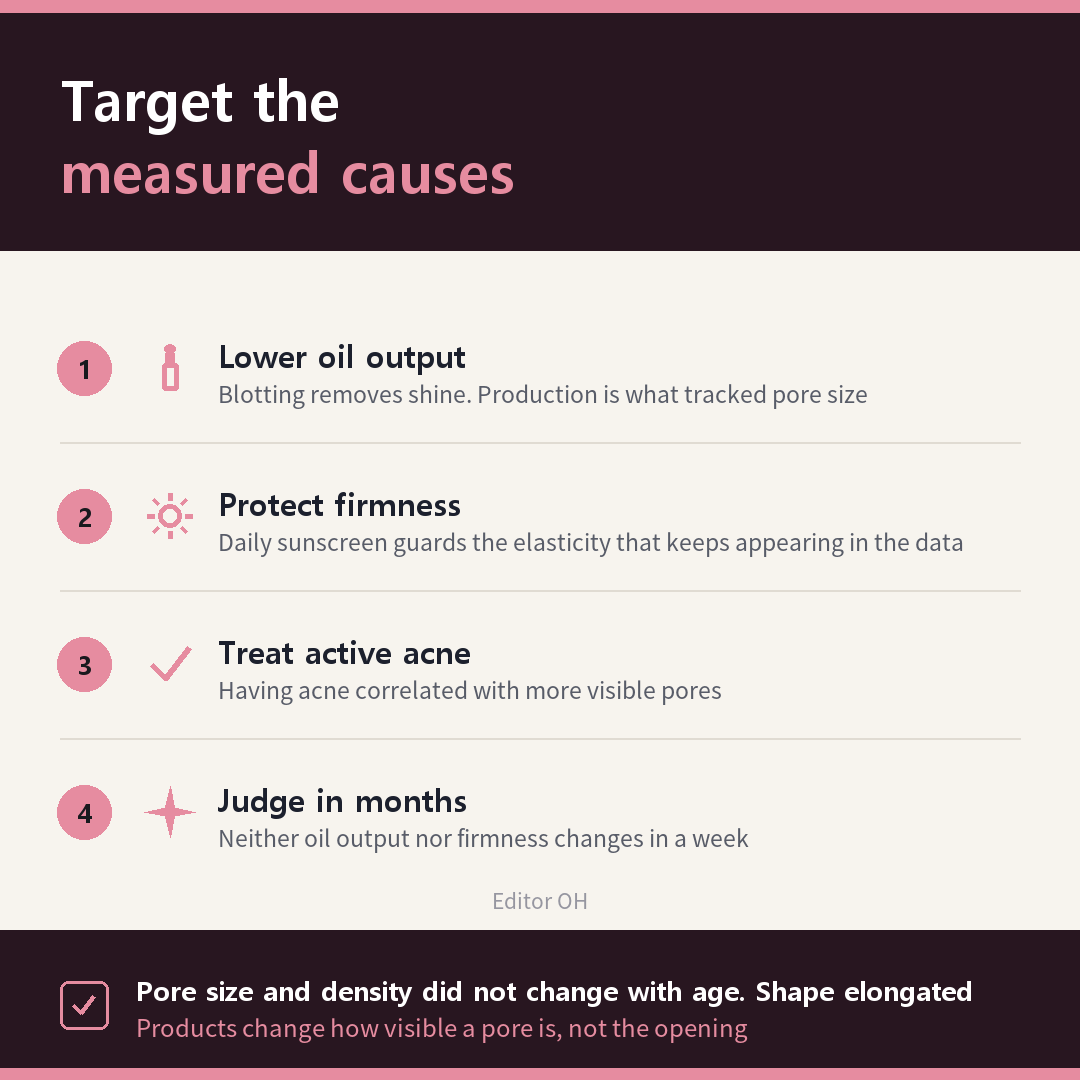
If oil and elasticity are the levers, a routine should work on those two and not on the pore itself.
- Manage oil output, not just surface shine: blotting removes what is there, but what matters in these studies is how much is produced. Topical niacinamide at 2 percent lowered sebum excretion in one population
- Protect elasticity with daily sunscreen: sun exposure is a well established driver of lost firmness, and firmness is the second variable that keeps appearing
- Treat active acne: having acne correlated with more visible pores in the Korean study
- Judge progress in months: neither oil output nor elasticity changes in a week
The downside of chasing a smaller pore
Products promising to shrink pores are working against anatomy. The opening is part of the follicle, and nothing in these studies suggests a cream closes it.
What products can do is change how conspicuous it looks. Less oil in the opening and firmer skin around it both reduce how visible a pore reads. That is a real improvement, but it is appearance, and it tends to reverse when the routine stops.
Procedures sit in a different category. Clinical studies of radiofrequency, injectables and light devices have reported reductions in measured pore volume, some lasting months. They carry cost and side effects, and they are a dermatologist's decision rather than a routine step.
Several studies here were small, and some were run by cosmetic companies. The oil and elasticity pattern is consistent across them, but the effect sizes are modest.
The bottom line
Large pores are not simply an age problem. In the measurements, oil output and skin elasticity tracked pore size, and age mostly changed pore shape.
So the useful targets are the two variables you can influence. The concentration evidence for oil control is in the niacinamide guide, and why oily skin still needs barrier care is in the oily skin guide.
The studies above are indexed on PubMed. The Korean factor study is Sebum, acne, skin elasticity, and gender difference, and the aging shape study is A new tool to quantify the geometrical characteristics of facial skin pores.
The IGF-1 study is Serum levels of IGF-1 are related to human skin characteristics, and the 2026 barrier study is Enlarged facial pores are associated with skin barrier impairment. Korean cosmetic regulation is administered by the Ministry of Food and Drug Safety.
In short: oil and firmness track pore size. Age mostly stretches the shape. Work on oil output and elasticity, expect changes in appearance rather than a smaller opening, and measure progress in months.
Did your pores look different after your oil level changed, and what changed it? Leave a comment. If enough cases come in, the next round can split them by skin type.
This article summarises published research for general information and does not replace medical advice, diagnosis or treatment. Skin responses vary between individuals, and procedures for pore appearance should be discussed with a qualified professional.
Comments
Post a Comment