Pimple patches moved from the pharmacy wound-care aisle to the front of every K-beauty shelf in about five years. The instruction manual did not travel with them.
Two different products are sold under one name. They work by opposite mechanisms, and most people buy whichever box looks nicer.
That is why the most common review reads some version of "these did nothing for me." Usually the patch was fine and the match was wrong. Here is what each type does and which spot it belongs on.

What it is: a wound dressing, borrowed
The classic pimple patch is hydrocolloid, and it did not start in skincare at all. Hydrocolloid dressings have been standard in clinical wound care for decades, used on ulcers, burns and post-surgical sites.
The mechanism is simple. The patch contains gel-forming agents that absorb fluid from the surface. As they pull in exudate, they swell into a soft gel and seal the area under an occlusive film.
That gel keeps the surface moist rather than letting it dry into a hard scab. Moist healing is the whole point.
Skin repairs faster when the surface stays hydrated, because new cells migrate across a moist bed far more easily than across dry crust. The result is quicker re-epithelialization and, in the wound-care literature, less scarring than dry healing.
There is a second effect that nobody designed but everyone benefits from: the patch is a physical lid. It stops fingers. A spot you cannot touch for eight hours is a spot that does not get squeezed at midnight.
What the research supports
A 2025 narrative review of hydrocolloids in dermatology found the evidence base strongest for chronic and acute wounds. Acne-specific work exists but is still a small body of literature rather than a settled one.
The acne data that does exist points in a consistent direction. In clinical grading of facial acne, hydrocolloid patches produced significant improvements in smoothness, crusting and scabbing, redness, lesion diameter, elevation and surface dryness.
Those gains were measured on lesions that had already been opened. Closed lesions showed a significantly greater reduction in size by day four.
So the honest summary is this: real effects, modest evidence volume, and best documented on the exact situation people reach for them anyway, which is a spot that has already broken the surface.
The microneedle patch is a different tool
Microneedle patches look similar and do the opposite thing. Instead of absorbing outward, they deliver inward.
The patch carries an array of tiny dissolving spikes, usually built from hyaluronic acid and loaded with active ingredients. Pressed onto skin, the spikes soften and dissolve, releasing their payload past the outermost barrier layer.
This solves a genuine limitation. The stratum corneum is very good at keeping things out, which is inconvenient when the thing being kept out is a treatment ingredient aimed at a bump sitting under intact skin.
A four-week split-face study in twenty adults compared microneedle patches containing salicylic acid against patches containing EGCG and against control patches.
Both actives produced clinical improvement, salicylic acid outperformed the others, and the advantage was clearest on non-inflammatory lesions. No adverse effects were recorded.
More recent work on dissolving microneedles combining salicylic acid with soothing and hydrating agents reported reductions in both acne lesions and the pigmented marks left behind, again without adverse skin reactions.
Matching the patch to the spot
Once you separate absorbing from delivering, the choice stops being a brand question.
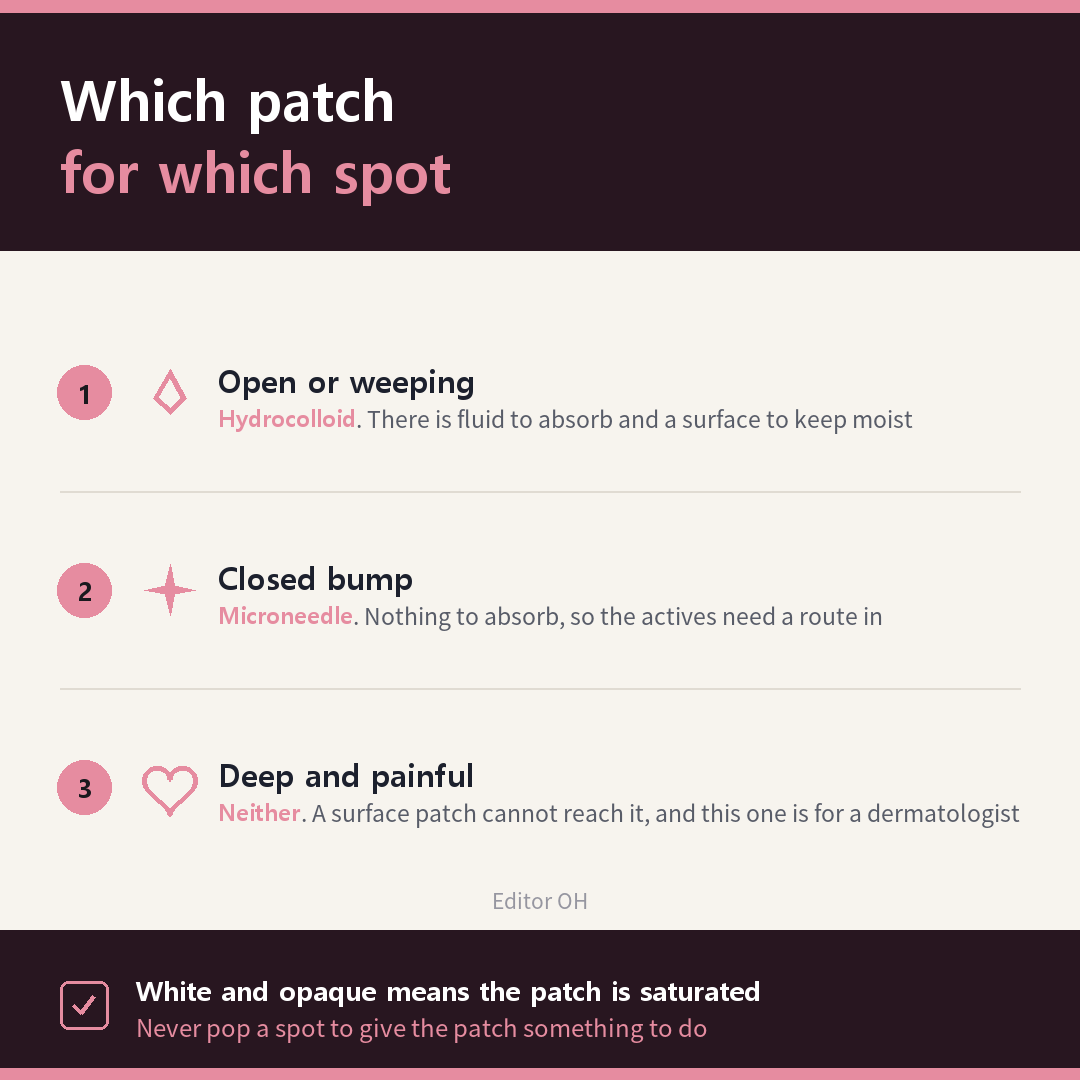
| What the spot looks like | Which patch | Why |
|---|---|---|
| Open, weeping, already popped | Hydrocolloid | There is fluid to absorb and a surface to keep moist |
| Closed bump, no opening | Microneedle | Nothing to absorb, so actives need a route in |
| Deep, painful, under the skin | Neither | Too deep for a surface patch to reach |
| Flat red or brown mark left behind | Neither, mainly | That is pigment, and pigment takes time and different actives |
The third row is the one worth taking seriously. Deep painful nodules are not a patch problem, and stacking patches on them tends to produce irritation plus disappointment. That is a conversation for a dermatologist, not a shelf.
The downside nobody puts on the box
Patches are low risk, not zero risk, and a few failure modes come up repeatedly.
- Occlusion with nothing to absorb: a hydrocolloid patch on a sealed bump has no exudate to draw. It seals the area and little else
- Leaving one on too long: once the patch has turned white and opaque it is saturated. Past that point it is a damp lid, and surrounding skin can macerate
- Adhesive irritation: repeated application to the same area, particularly on skin already sensitized by retinoids or exfoliating acids, can leave a red square that outlasts the spot
- Stinging from actives: microneedle patches deliver ingredients past the barrier, so a salicylic acid formula can sting in a way a serum would not
- Treating a spot tool as a routine: neither type prevents the next breakout. They manage what has already appeared
How to use them without making it worse
Application matters more than brand, and the errors are consistent.
- Fully dry, bare skin: apply to clean skin with no serum, oil or cream underneath. Residue is the single most common reason a patch slides off within an hour
- Do not pop it first: opening a lesion deliberately so the patch has something to draw is how a small spot becomes a mark that lasts months
- Change hydrocolloid when it turns white: that colour change is the signal it has done its job
- Press microneedles and leave them: firm pressure for a few seconds, then overnight. The spikes need time to dissolve
- Give the skin a break: rotate the area rather than patching the same square nightly for a week
The bottom line
Hydrocolloid absorbs and protects. Microneedles deliver. They are not competing versions of one product, and the patch that "did nothing" was probably the wrong mechanism for that particular spot.
Neither is a treatment plan. Persistent, painful or widespread breakouts are worth taking to a dermatologist rather than managing one square at a time.
If patches are irritating skin that is already sensitized, the routine around them is usually the place to look. The cleansing step is covered in the double cleansing guide, and the calming side is covered in what the evidence says about centella.
The hydrocolloid evidence above comes from a 2025 narrative review of hydrocolloids in dermatology, and the microneedle research is indexed on PubMed.
Korean regulatory classifications for cosmetics and quasi-drugs are published by the Ministry of Food and Drug Safety.
In short: hydrocolloid for anything open or weeping, microneedle for anything closed, and neither for what sits deep under the skin. The patch that failed you was probably the right product on the wrong spot.
Which type has actually worked on your skin, and on what kind of spot? Leave a comment. If enough cases come in, the next round can break it down by lesion type.
This article is for general information and does not replace medical advice, diagnosis or treatment. Skin responses vary between individuals, and persistent or severe breakouts should be assessed by a qualified professional.
Comments
Post a Comment