A spot clears and leaves a brown mark behind. Months later the mark is still there, and the routine aimed at it keeps growing.
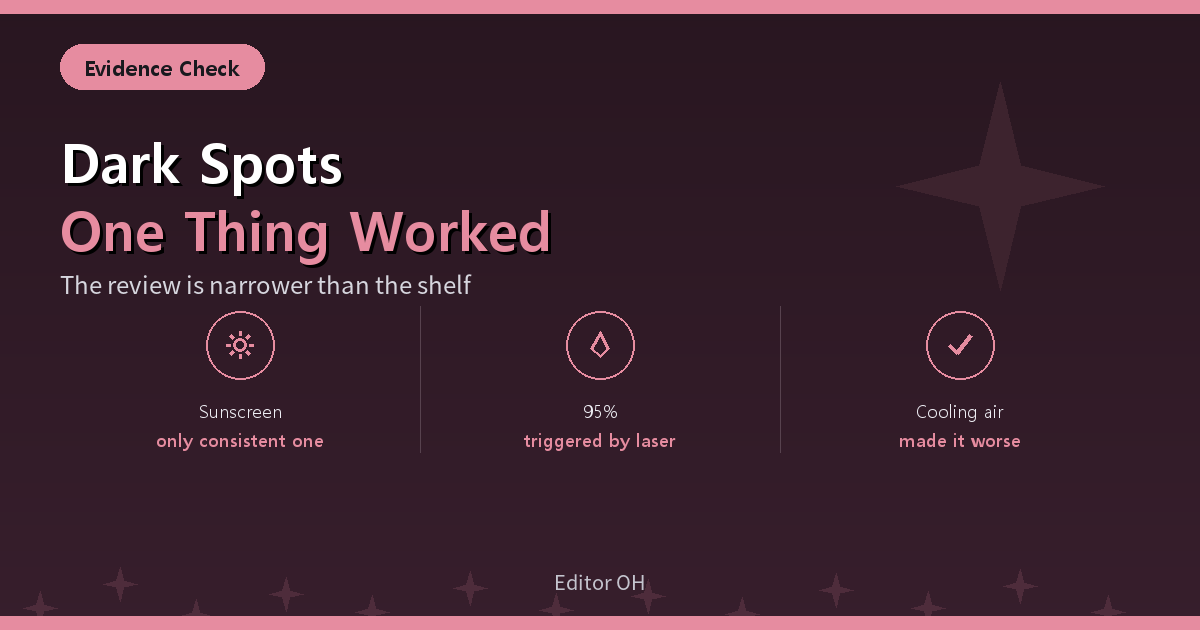
There is a systematic review that looked specifically at preventing this, and the result is narrower than the shelf suggests. One measure worked consistently. Several respected ones did not, and one made things worse.
Here is what the evidence supports, what it does not, and how to act before the mark forms rather than after.
What it is: pigment left behind
Post-inflammatory hyperpigmentation, usually shortened to PIH, is the darkening left behind after skin has been inflamed or injured.
It affects every skin tone, but the review notes a heightened predilection for Fitzpatrick skin types III to VI. More melanin available means more pigment deposited when the process is triggered.
That is worth stating plainly because most English-language routine advice is built around a population where this happens less often.
The review
The systematic review pooled 14 studies covering 369 cases. Two details set the scene.
| Detail | Figure |
|---|---|
| Cases | 369 across 14 studies |
| Ethnicity | All Asian |
| Mean age | 38 |
| Trigger | Laser therapy in over 95 percent |
| Location | Face in 85 percent |
Read the fourth row again. In this body of evidence, the pigmentation was overwhelmingly triggered by a procedure people sought out, often to treat pigmentation in the first place.
What worked, what did not
The findings split cleanly.
- Sunscreen, alone or combined with other ingredients, was the most successful preventative measure. The authors state that only sunscreen consistently prevented the incidence of PIH
- Topical corticosteroids showed less successful outcomes
- Systemic tranexamic acid also showed less successful outcomes
- Cooling air devices exacerbated the development of PIH
The last line is the one that stops you. Cooling air is used during procedures for comfort and to protect the surface. In this review it was associated with more pigmentation, not less.
That does not make cooling wrong in every context, and this is a review of 369 cases rather than a verdict. It does mean the assumption that anything soothing must also be protective does not survive contact with the data.
Prevention beats treatment here
The reason this matters is asymmetry. Preventing the mark takes one habit. Removing it takes months.
An international expert consensus on melasma, a different pigmentary condition that often sits alongside PIH, lands in the same place on the first step. Photoprotection with broad-spectrum sunscreen is described as essential, not optional or supplementary.
The consensus lists the rest as a hierarchy. Regulated and supervised hydroquinone-based triple combination creams are called the gold standard.
Azelaic acid, kojic acid and oral tranexamic acid appear as alternatives. Chemical peels and microneedling are adjunctive. Lasers are reserved for refractory cases.
Put that next to the review above and a loop appears. Laser sits at the bottom of the list for melasma, and laser is what triggered PIH in more than 95 percent of the reviewed cases.
How to act on this
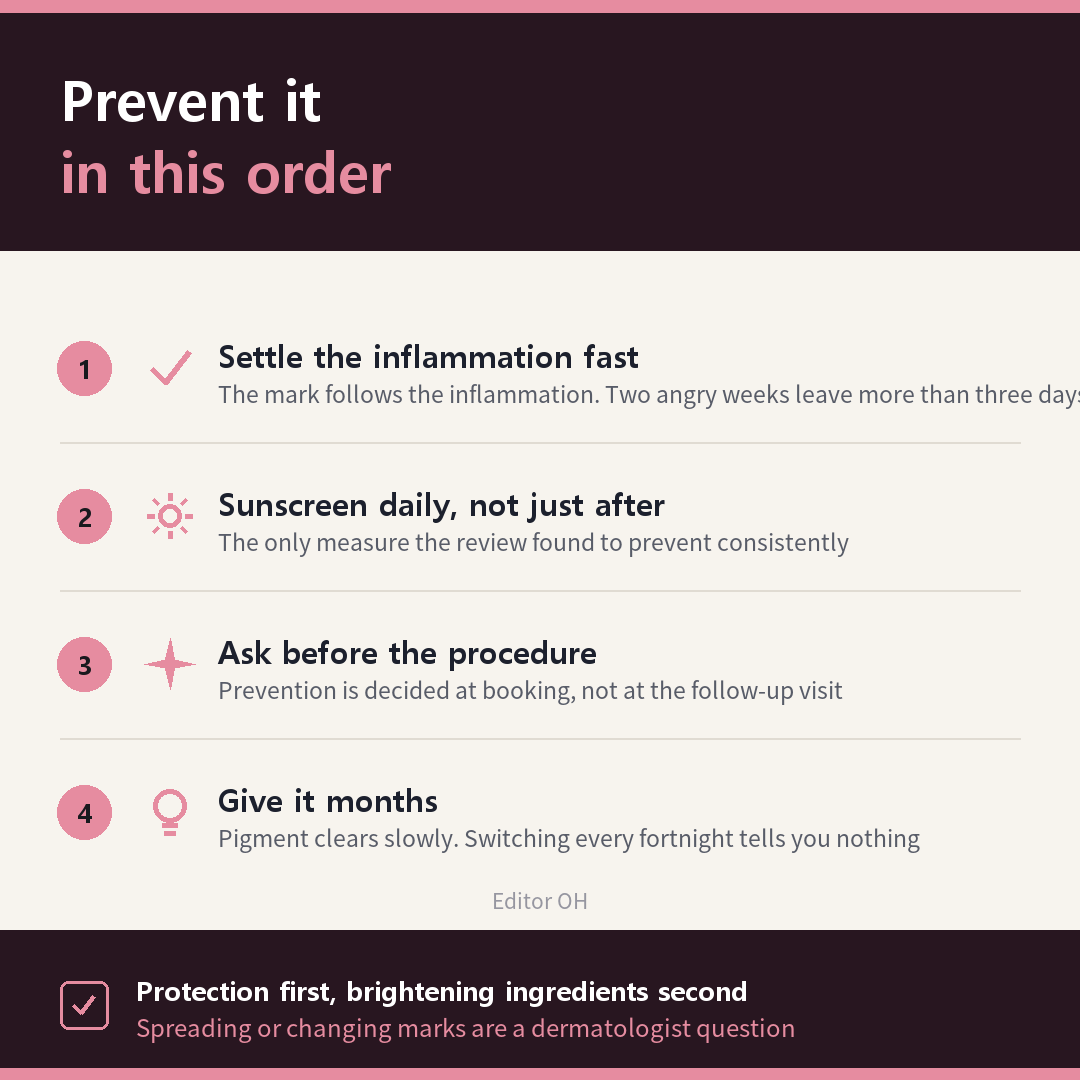
- Treat the inflammation early: the mark follows the inflammation. A spot that stays angry for two weeks leaves more behind than one that settles in three days
- Do not pick: mechanical injury extends the inflammatory phase, which is the input to the whole process
- Use sunscreen daily, not just after a procedure: this is the only measure the review found to work consistently
- If you are booking a procedure, ask about the after-plan first: prevention is decided before the appointment, not at the follow-up
- Give actives months, not weeks: pigment clears slowly, and switching products every fortnight guarantees you never find out what worked
The downside of reading this too narrowly
It does not mean brightening ingredients are useless. The consensus lists several with a place in treatment, and a separate trial of a topical regimen with sunscreen reported measurable reduction in pigment over 90 days.
It does mean the order is fixed. Protection first, then ingredients. An active working against daily unprotected exposure is fighting the input while you keep supplying it.
And a practical limit: the studies above are mostly on procedure-triggered pigmentation in adults with Fitzpatrick III to V. Marks that are spreading, changing shape or not fading at all are a dermatologist's question rather than a routine one.
The bottom line
Across 14 studies, one preventative measure held up. Corticosteroids and tranexamic acid did less than expected, and cooling air did the opposite of what it was there for.
The boring answer is the evidenced one. Sunscreen, daily, before the mark exists. Everything else on the shelf is working on a problem you can largely avoid creating.
The inflammation side of this is covered in the pimple patch breakdown, which explains why occluding the wrong kind of lesion prolongs it, and the barrier conditions that keep skin reactive are in the oily skin and barrier guide.
The studies above are indexed on PubMed. The prevention review is Prevention of Post-Inflammatory Hyperpigmentation in Skin of Colour.
The expert consensus is Delphi consensus on melasma management, and a topical regimen trial is reported in Journal of Cosmetic Dermatology.
Korean cosmetic regulation is administered by the Ministry of Food and Drug Safety.
In short: only one measure consistently prevented the mark, and it was the least interesting one. Steroids and tranexamic acid underperformed, and cooling air made it worse. Protection first, ingredients second.
How long did a dark mark take to fade for you, and what were you using? Leave a comment. If enough cases come in, the next round can break it down by trigger.
This article summarises published research for general information and does not replace medical advice, diagnosis or treatment. Pigmentary responses vary between individuals, and marks that are spreading, changing or persistent should be assessed by a qualified professional.
Comments
Post a Comment