Panthenol appears near the bottom of a lot of Korean ingredient lists and almost never on the front of the box. It is the ingredient a brand mentions when it has nothing more exciting to say.
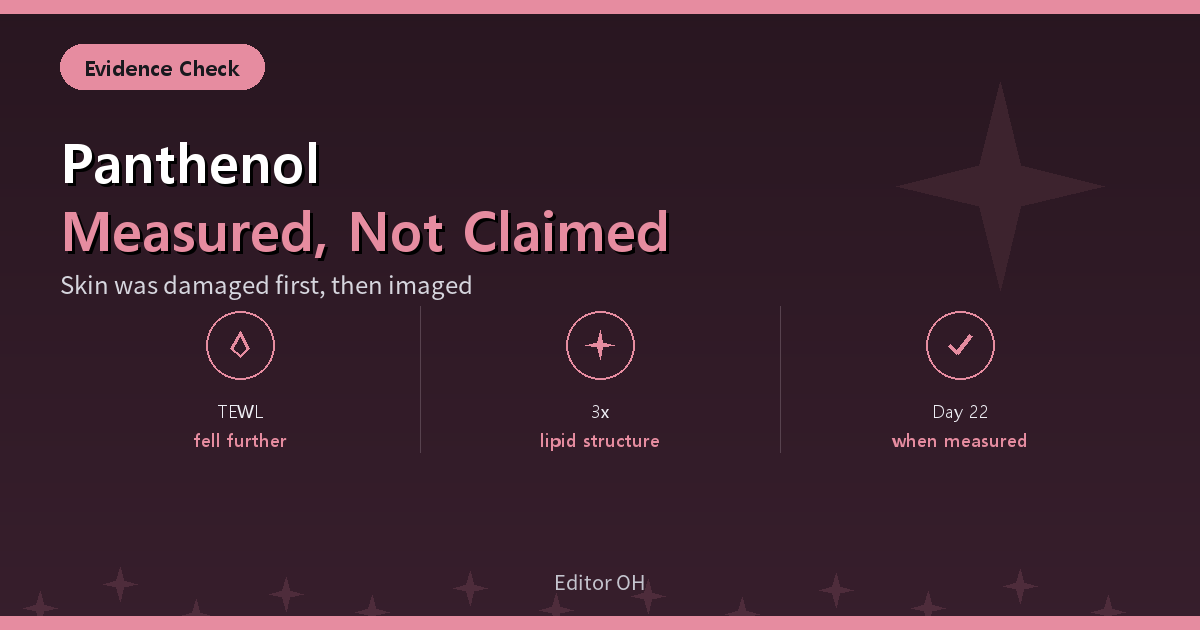
That is a strange fate for one of the few barrier ingredients with a controlled trial behind it. Researchers damaged healthy skin on purpose with a detergent, treated it, and measured the repair with an electron microscope.
Here is what that trial measured, what the numbers mean in plain terms, and where panthenol fits in a routine.
What it is
Panthenol is the alcohol form of vitamin B5. On an ingredient list it shows up as panthenol, D-panthenol or dexpanthenol. In skin it converts to pantothenic acid.
Its everyday job is humectant: it holds water. The more interesting claim is barrier repair, and that claim is the one the trial below set out to test.
It also has a long history in pharmacy rather than cosmetics. Wound and nappy-rash creams have used it for decades, which is part of why it reads as unglamorous.
The trial damaged skin first
The study used an intra-individual design with 23 healthy participants.
Two areas of skin were compared. One was challenged with a 0.5 percent sodium dodecyl sulfate solution, a detergent used in research to strip the barrier, and one was left alone. Both were treated with a panthenol-containing emollient for three weeks.
Three things were measured: water loss through the skin, surface hydration, and the organisation of the lipid layers between skin cells, imaged by electron microscopy.
| Measure | Result vs control |
|---|---|
| Water loss (TEWL) | Larger reduction, −168.36 vs −123.38 |
| Surface hydration | Significant improvement |
| Lipid lamellae length | 120.61 vs 35.85 nm per 1000 nm at day 22 |
The last row is the one worth slowing down on, because it is not a comfort rating or a questionnaire. It is a picture of the skin's internal structure, counted in nanometres.
What the lipid measurement means
Between the cells of the outer skin layer sit sheets of lipid. They are what make the barrier a barrier, and a detergent disrupts them.
The study measured how much continuous, well-organised lipid structure appeared in a given stretch of tissue. After three weeks the treated side showed more than three times the organised lipid length of the control side.
That is a structural reading, not a feel or a self-report. It is the difference between a cream that makes skin feel less tight and one with evidence that the wall itself reassembled.
A second study in the same paper looked at bacteria after a wash stress with a stronger detergent. Use of the emollient had no negative impact on bacterial viability, which matters because barrier products sit on skin all day.
Where it fits in a routine
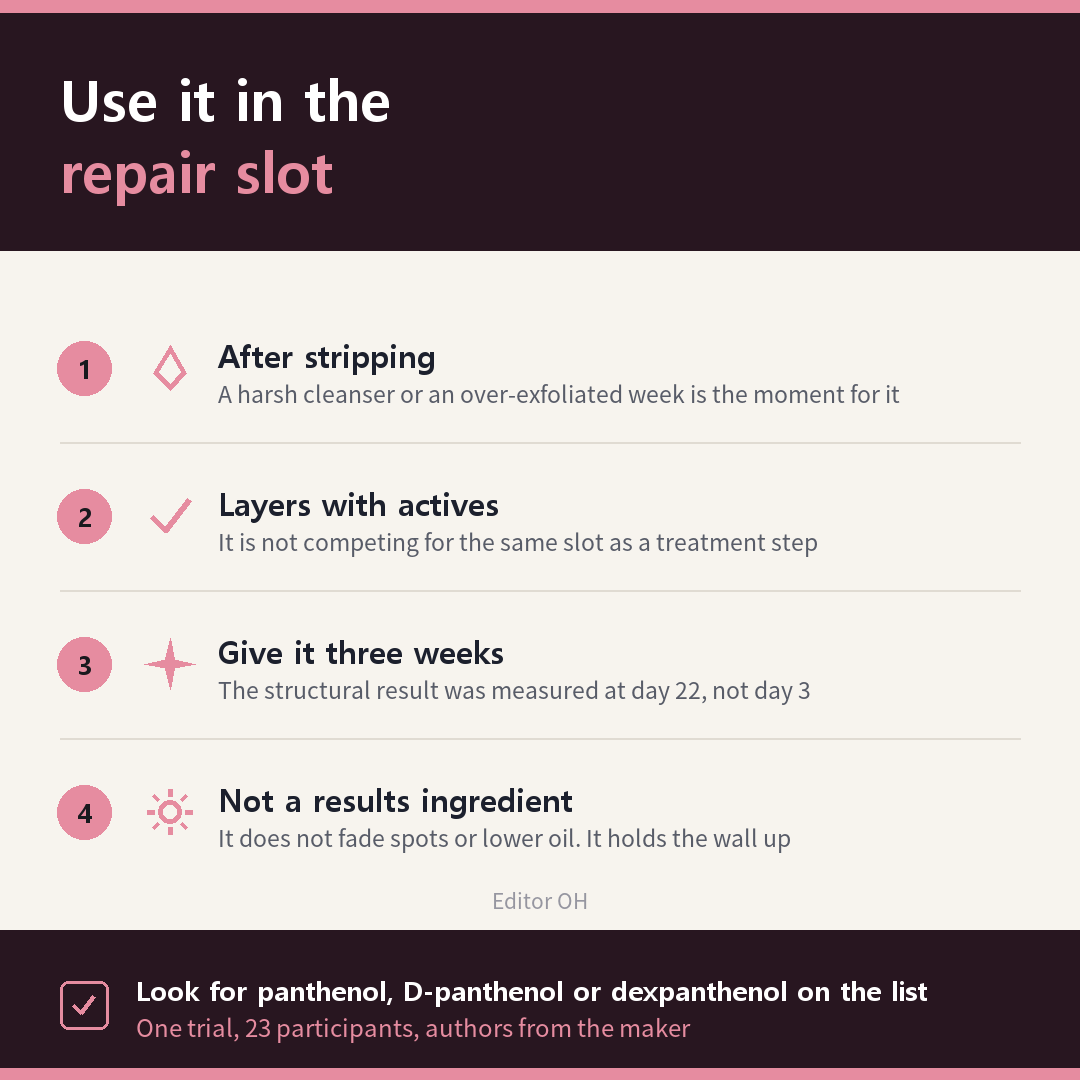
- After something stripped the barrier: a strong cleanser, an over-exfoliated week, a cold dry commute
- Alongside actives that irritate: it is not an active competing for the same slot, so it layers under or over most things
- In the buffer position: many Korean formulas pair it with panthenol-friendly humectants rather than making it the star
- For three weeks, not three days: the lipid result was measured at day 22, so judge it on that timescale
The downsides and the limits
The obvious limit is the study itself. Twenty-three people, one formula, a laboratory-induced injury rather than everyday damage, and authors from the company that makes the emollient.
The intra-individual design is a real strength, since each person served as their own comparison and nobody had to be matched to a stranger's skin. Even so, this is one trial of one formula, and the detergent that created the damage is harsher and faster than what a cleanser does over a winter.
The other limit is the ingredient's modesty. Panthenol does not fade spots, does not lower oil output, and does not replace treatment for a skin condition. It supports the barrier, and a supported barrier is what lets the rest of a routine be tolerated.
Cost is the quiet advantage here. This is an old, cheap, widely available ingredient, so paying a premium for it is rarely necessary.
Contact allergy to panthenol is reported but uncommon. As with anything, a product that stings on damaged skin is telling you something regardless of the ingredient list.
The bottom line
Panthenol is the ingredient that gets skipped in marketing and earns its place in measurements. Treated skin showed more than three times the organised lipid structure of untreated skin after three weeks, plus lower water loss and better hydration.
So it belongs in the repair slot of a routine rather than the results slot. The concentration question for oil and spots is in the niacinamide guide, and the hydration side, where molecular weight decides the outcome, is in the hyaluronic acid guide.
The trial is indexed on PubMed as A new topical panthenol-containing emollient: results from two randomized controlled studies, published in the Journal of Dermatological Treatment.
Korean cosmetic regulation is administered by the Ministry of Food and Drug Safety.
In short: the boring ingredient has the structural evidence. Panthenol reduced water loss, raised hydration, and tripled organised lipid length after damage. Use it to repair, not to transform.
Do you keep a panthenol product for the weeks a routine goes wrong? Leave a comment. If enough cases come in, the next round can look at what people reach for after over-exfoliating.
This article summarises published research for general information and does not replace medical advice, diagnosis or treatment. Skin responses vary between individuals, and damaged or persistently irritated skin should be assessed by a qualified professional.
Comments
Post a Comment